2026 Top Flange Accessory Types for Global Buyers
For global buyers, choosing a Flange Accessory is not a minor purchasing detail. The right component can support a reliable connection; the wrong one can cause delays, fit-up problems, or costly rework. This guide introduces common options, including gaskets, bolting, blind flanges, spacers, and spectacle blinds. Small parts matter.
Names and product ranges can vary between suppliers. Buyers should compare drawings, dimensions, materials, pressure ratings, and operating temperatures before requesting a quote. A gasket that looks suitable may not match the flange face or service conditions. A bolt set may also require careful checks for length, grade, and coating. Details count.
International procurement adds another layer. Specifications should identify the applicable standard and revision, rather than relying on a product label alone. Ask suppliers for traceable material documentation, inspection records, and clear dimensional data when the application requires them. Confirm packaging and marking requirements early, especially for mixed orders. It saves time.
This overview is intended to help purchasing teams ask more precise questions and shortlist products with confidence. It does not replace engineering review, project specifications, or supplier verification. That distinction matters. In practice, even experienced buyers can miss a small interface detail when schedules are tight. A useful comparison starts with the actual piping design, service conditions, and installation plan—not a broad catalog description. The following sections explain what each accessory does, where buyers commonly use it, and which checks deserve attention before ordering.
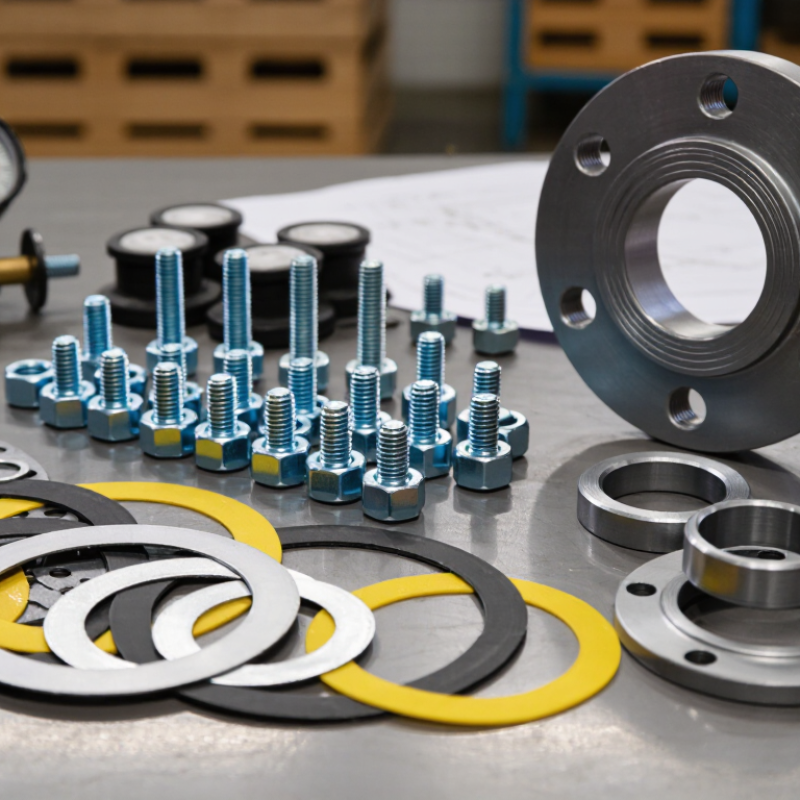
Flange Accessories Explained: Gaskets, Bolts, Washers, and Insulation Kits
Flange accessories are small components with large consequences. A gasket must match the flange face, fluid, temperature, and pressure—not just the nominal pipe size. ASME B16.20 covers metallic gaskets, while ASME B16.21 covers nonmetallic flat gaskets. These standards help buyers specify dimensions and construction consistently. They do not replace checking chemical compatibility or site conditions. A spiral-wound gasket, for example, may suit one service but be unsuitable for another.
Bolts and washers need equal care. ASME B16.5-2020 covers flange dimensions and pressure-temperature ratings across Classes 150 through 2500, giving buyers a common basis for matching flange assemblies. Confirm bolt material, diameter, length, and thread before ordering; a bolt that is slightly too short may not provide adequate engagement. Washers help distribute load, but they cannot correct uneven tightening. Small parts matter.
Insulation kits use sleeves and washers to electrically separate connected flanges, helping limit galvanic corrosion where dissimilar metals meet. Check kit dimensions against the flange, bolt circle, and operating conditions. Keep materials traceable to their specifications, and inspect sealing faces for scratches before assembly. A tidy parts list is useful, but it can miss field variation. Measure the actual joint when possible; drawings are not always current.
ASME B16.5: NPS ½–24; Classes 150, 300, 400, 600, 900, 1500, and 2500
For global buyers, flange selection starts with the connection, not the catalog photo. ASME B16.5 covers flanges and flanged fittings from NPS ½ through NPS 24. Its pressure classes are 150, 300, 400, 600, 900, 1500, and 2500. The class number alone does not state a safe working pressure; allowable pressure varies with material and temperature.
Common choices include weld-neck flanges for demanding piping, slip-on flanges for simpler fabrication, and blind flanges for closing a line or vessel opening. Threaded and socket-weld designs suit particular connection methods, while lap-joint flanges pair with stub ends where easier alignment matters. Details matter. Check the facing, bolt pattern, bore, and mating flange together. A small mismatch can complicate installation.
Before ordering, confirm the NPS, class, material, facing finish, and applicable dimensional requirements against the project documents. Also verify whether the selected fitting falls within the standard’s scope; “B16.5” on a datasheet is not a substitute for checking its actual dimensions. Class 150 and Class 2500 serve very different conditions. A tidy comparison chart helps, but it cannot resolve every service detail. I would double-check temperature and material assumptions with the responsible piping engineer, especially when specifications are incomplete.
ASME B16.20 Metallic Gaskets: Ring-Joint, Spiral-Wound, and Metal-Jacketed Types
ASME B16.20 metallic gaskets include ring-joint, spiral-wound, and metal-jacketed designs. Each suits different flange geometry and service conditions. Ring-joint gaskets seat in precisely machined grooves, creating a metal-to-metal seal. Spiral-wound types combine a formed metal strip with compressible filler, often with centering rings. Metal-jacketed gaskets enclose filler within a shaped metal shell and are common in heat exchangers. Details matter.
Tips: Check the flange face, groove dimensions, gasket style, and material compatibility before ordering. Confirm the applicable ASME B16.20 edition and specify dimensions clearly. A drawing can prevent avoidable mismatches.
Do not select by pressure rating alone. Temperature, fluid, flange condition, and installation practices also affect performance. For ring-joint styles, inspect the groove for damage or debris. Spiral-wound gaskets need even compression; uneven bolt loading can cause leakage. Metal-jacketed designs may suit particular exchanger channels, but available space and flange finish still matter. Selection is not always tidy: operating data can be incomplete, so verify assumptions with the plant’s engineering team before finalizing the specification.
2026 Top Flange Accessory Types for Global Buyers — ASME B16.20 Metallic Gaskets: Ring-Joint, Spiral-Wound, and Metal-Jacketed Types
Selection note: ASME B16.20 covers specified metallic gasket dimensions, materials, and marking requirements. Pressure-temperature suitability is not determined by gasket type alone; verify the applicable flange standard, gasket design, materials, process conditions, and current standard edition before purchase.
Selection Checks: Match Flange Facing, Pressure Class, Material, and Service Temperature
2026 Top Flange Accessory Types for Global Buyers
Selection Checks: Match Flange Facing, Pressure Class, Material, and Service Temperature
Match the accessory’s facing to the flange before comparing price. Raised-face, flat-face, and ring-type-joint connections need compatible gasket styles and contact surfaces. A mismatched face can leave uneven compression around the bolt circle. Small mismatch. Big leak risk. ASME B16.5-2020 pressure-temperature tables show why class alone is not a working pressure: ratings vary with material group and temperature. Check the applicable table for the exact flange material and operating conditions, rather than treating “Class 300” as a universal pressure value.
Material selection needs the same care. Check the process fluid, corrosion exposure, and temperature range against the accessory’s material specification and the project’s requirements. ASME B16.5-2020 provides pressure-temperature ratings for listed flange materials; it does not replace a corrosion assessment for a particular service. For hot lines, review both continuous and upset temperatures, including start-up and cleaning cycles. For cold service, verify the specified minimum temperature and material toughness requirements. One detail is easy to overlook: bolts, gaskets, and flange accessories must work as a set. Confirm dimensions, facing, class, material, and temperature limits on the drawings and certificates. If the service conditions are incomplete, pause procurement and resolve the gap; a neat data sheet can still hide an assumption.
2026 Top Flange Accessory Types for Global Buyers — Selection Checks: Match Flange Facing, Pressure Class, Material, and Service Temperature
How to read the chart: The bars show ASME B16.5 pressure class designations, not pressure values in psi or bar. Allowable pressure depends on the applicable standard, material group, size, and service temperature.
For blind, weld-neck, slip-on, threaded, socket-weld, or lap-joint flanges, verify facing compatibility (such as RF, FF, or RTJ), pressure class, material, and temperature limits against the project specification and governing standard before ordering.




