
Direct-to-film printing is moving from small workshops into structured textile production. Grand View Research identifies digital textile printing as a high-growth market, driven by short runs, customization, and faster product cycles. Smithers’ “The Future of Digital Textile Printing to 2028” also highlights ink reliability as a practical barrier to wider adoption.
This is where Anti Clogging Dtf Ink becomes important. Its formulation is designed to reduce pigment settling, nozzle-surface drying, and unstable ink flow. In practice, that means fewer blocked nozzles after overnight pauses. It also means cleaner white-ink circulation and more consistent transfer density. However, no ink can compensate for poor storage, excessive heat, or neglected printer maintenance.
Inkjet specialist Frank J. Cost described the underlying challenge clearly: “Inkjet printing is a fluid mechanics problem disguised as a printing problem.” His observation applies directly to DTF systems. Pigment size, viscosity, surface tension, filtration, and circulation must work together. A single weak point can create banding, missing dots, or wasteful cleaning cycles.
The details are visible at the printhead. A partially blocked nozzle may leave a thin gap in a solid white layer. That small defect can become obvious after powder curing and heat pressing. Anti-clogging technology helps, but it is not magic. Operators still need regular agitation, controlled humidity, and manufacturer-approved cleaning procedures.
This guide explains what Anti Clogging Dtf Ink contains, how it works, and where its limits remain. Some claims sound impressive. Real production results deserve closer inspection.
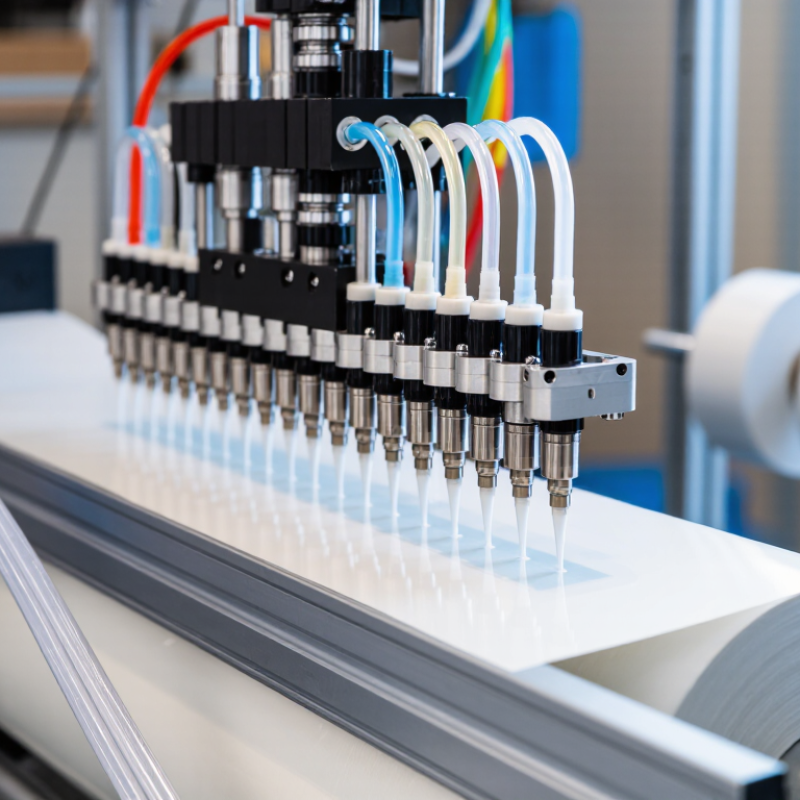
Anti-clogging DTF ink is formulated to keep printer nozzles open during film-transfer production. It usually contains finely milled pigment, balanced dispersants, humectants, and controlled surface-tension agents. These ingredients help pigment particles remain suspended instead of forming sediment. The ink must also dry into a flexible image layer after powder application. Too much moisture, however, may weaken powder adhesion. The balance is not simple.
White ink needs extra attention. Its heavier pigment load can settle during overnight pauses, especially near the printhead. Anti-clogging formulas reduce this risk through smaller particle distribution and improved dispersion stability. Some systems also use gentle circulation, filtration, and scheduled nozzle checks. According to Grand View Research, the global digital textile printing market was valued at about USD 2.72 billion in 2023, with strong growth forecast through 2030. That expansion increases demand for dependable ink behavior. Smithers’ digital textile printing research also highlights productivity and reduced waste as important industry priorities.
In practical use, operators should shake or circulate ink as directed. Keep storage areas stable and clean. A dusty capping station can defeat good chemistry. No ink is truly clog-proof. This matters. A printer may still develop blocked nozzles after long idle periods, poor maintenance, expired ink, or incompatible film settings. Testing should include a small nozzle pattern, white-ink settling checks, wash resistance, stretch recovery, and transfer adhesion. Results can vary between printheads, humidity levels, and powder temperatures. That variability deserves honest review.
What Is Anti Clogging DTF Ink and How Does It Work?
Anti-clogging DTF ink is designed to keep pigment moving through narrow printhead channels. Its performance depends more on formulation balance than on one special additive. Water carries the pigment, while humectants slow evaporation around the nozzle. Dispersants separate pigment particles and reduce agglomeration. Surfactants control surface tension, supporting cleaner droplet formation. A stable DTF formula often targets 8–12 mPa·s viscosity and 25–35 mN/m surface tension. These ranges can vary by printhead design. They are not universal rules.
White ink requires extra attention because its pigment load is higher. Poor dispersion can create sediment at the cartridge bottom or tiny deposits near the nozzle plate. Manufacturers therefore use controlled milling, filtration, pH buffering, and compatible preservatives. The 2024 Grand View Research DTF printing market report projects an estimated 11.5% compound annual growth rate from 2024 to 2030. That growth increases pressure for longer unattended runs and fewer maintenance interruptions. Still, “anti-clogging” does not mean clog-proof. Temperature, humidity, storage time, and idle periods can defeat a good formula.
Tips: Shake white ink gently before use, not violently. Keep storage near the supplier’s recommended temperature. Print a small nozzle check after long idle periods. Do not mix unfamiliar inks. A practical test should monitor missing nozzles, sediment, viscosity, and wash durability over several weeks. One overlooked issue is real-world variability. Laboratory stability may not match a dusty workshop or a hot production room.
| Formulation Dimension | Typical Specification or Range | How It Helps Prevent Clogging | Practical Control Considerations |
|---|---|---|---|
| Ink Type | Water-based pigment ink formulated for direct-to-film printing | Uses dispersed pigment particles rather than dissolved dyes, so particle stability is essential for reliable nozzle performance. | Ink should be matched to the printhead, film, powder, curing process, and printer circulation system. |
| Pigment Particle Size | Usually submicron; commonly controlled below approximately 200 nm for many digital pigment systems | Smaller, uniform particles are less likely to settle, agglomerate, or obstruct fine nozzle channels. | Particle-size distribution matters as much as average size. Oversized particles and agglomerates should be minimized through milling and filtration. |
| Pigment Dispersion | Stabilized with polymeric or other suitable dispersants | Dispersants help keep pigment particles separated and reduce flocculation during storage and printing. | Excess dispersant can affect drying, adhesion, foam, and water resistance, so the dosage must be balanced. |
| Viscosity | Often approximately 2–6 mPa·s at around 25°C, depending on the printhead design | Controlled viscosity allows consistent droplet formation and reduces the risk of poor jetting or nozzle starvation. | Always follow the printhead manufacturer’s operating window. Temperature changes can significantly alter viscosity. |
| Surface Tension | Commonly controlled within approximately 25–40 mN/m, depending on the inkjet system | Balanced surface tension supports stable droplet release and helps prevent satellite droplets and misdirected jets. | Too high a value can hinder jetting; too low a value may cause spreading, misting, or unstable meniscus behavior. |
| Humectants | Water-compatible moisture-retaining solvents such as glycerol, glycols, or similar materials | Humectants slow evaporation at the nozzle plate, helping prevent dried ink deposits during pauses or low-use periods. | Excessive humectant can lengthen drying time, reduce image sharpness, or interfere with transfer and curing. |
| Co-Solvents | Selected water-miscible solvents used within the printhead and substrate compatibility limits | Co-solvents help control evaporation rate, viscosity, wetting, and nozzle-open time. | The formulation must balance open time against drying speed. Solvent compatibility with seals and dampers is also important. |
| Wetting and Defoaming Additives | Low-dose additives selected for controlled wetting and reduced foam | Consistent wetting helps prevent uneven deposits, while low foam improves ink delivery and reduces air-related jetting faults. | Overuse may cause surface defects, poor layer formation, or changes in adhesion. Additives should be validated in the complete ink system. |
| pH Control | Frequently maintained in a mildly alkaline range, often about pH 8–10, depending on the pigment and printhead | A stable pH supports dispersion stability, preservative performance, and compatibility with ink-contact materials. | pH drift can promote pigment instability, corrosion, odor, or changes in viscosity. The correct range is formulation-specific. |
| Filtration | Fine staged filtration, commonly using approximately 1–5 micrometre final filters | Filtration removes oversized particles, agglomerates, and manufacturing debris before the ink reaches the printhead. | Filter selection must consider pigment loading, flow rate, pressure, and chemical compatibility. Filtration cannot replace good dispersion. |
| Storage Stability | Designed for uniformity during normal storage; specific shelf life depends on the formulation and packaging | Resistance to settling, separation, and agglomeration reduces the chance of concentrated particles entering the ink system. | Store sealed and protected from freezing, excessive heat, and direct sunlight. Gentle agitation may be recommended before use. |
| Temperature Control | Printing conditions are commonly maintained near room temperature, often approximately 20–30°C | Stable temperature keeps viscosity and surface tension within the intended jetting range. | Avoid rapid temperature changes and condensation. Printer-specific heating and environmental requirements should be followed. |
| Nozzle Maintenance | Routine circulation, wiping, capping, and periodic cleaning as required by the printer | Maintenance removes partially dried ink before deposits become hard or obstruct the nozzle opening. | Use compatible cleaning fluid and maintenance procedures. Do not mix unverified inks or cleaners in the same fluid path. |
| Common Clogging Triggers | Drying at the nozzle, pigment agglomeration, sedimentation, air ingress, contamination, and incompatible fluids | Identifying the trigger allows the operator to correct the root cause instead of relying only on repeated cleanings. | Check idle time, humidity, filter condition, damper performance, ink age, circulation, and printhead alignment. |
| Performance Verification | Nozzle checks, controlled test patterns, viscosity and pH checks, filtration checks, and accelerated stability testing | Regular verification detects missing nozzles, sedimentation, and formulation drift before print quality deteriorates. | Evaluate white ink separately because its higher pigment loading generally requires stronger circulation and more frequent maintenance. |
Note: The numerical ranges shown are representative industry formulation windows, not universal specifications. The correct values depend on the pigment chemistry, printhead architecture, ink delivery system, printer settings, and film-transfer process.
Anti-clogging DTF ink is designed to keep pigment particles evenly suspended during printing. Its controlled particle size reduces the chance of sediment collecting inside narrow printhead channels. Special dispersants help prevent pigments from sticking together. Humectants also slow evaporation around the nozzle plate, where tiny drops can dry quickly.
Practical Printing In practical printing, nozzle blockages often begin during pauses. A thin layer of ink dries over the nozzle openings, causing missing dots or broken lines. Anti-clogging ink helps maintain moisture and stable flow during these short interruptions. Its balanced viscosity allows ink to pass smoothly without excessive pressure. Proper surface tension also helps each drop form cleanly and land accurately on the film.
Important Maintenance The ink cannot solve every blockage. Poor storage, dusty work areas, or long idle periods can still create problems. Keep cartridges sealed and shake them gently when recommended. Check nozzle patterns before demanding jobs. A small test may reveal trouble early. One mistake is assuming “anti-clogging” means maintenance is unnecessary. It does not. Regular cleaning, correct temperature, and a properly capped printhead remain important. Inconsistent results may also come from incorrect settings rather than the ink itself. That detail is easy to overlook.
Anti-clogging DTF ink is formulated to keep pigment particles moving through tiny print nozzles. It usually combines controlled viscosity, stable surface tension, and fine particle dispersion. Humectants slow drying at the nozzle opening, while additives help reduce sedimentation inside the ink path. White ink needs special attention. Its heavier pigment load can settle faster when circulation is weak or printing pauses. Good formulations support steady jetting, sharp edges, and fewer missing dots during long runs. That matters on small lettering, where one blocked nozzle can create a visible white line.
From a production viewpoint, the main benefits are less downtime, lower cleaning waste, and more predictable transfer quality. Operators may also see smoother gradients and more consistent opacity across dark garments. However, anti-clogging performance is not permanent protection. Humidity, dust, expired ink, poor storage, and incorrect curing can still damage results. Keep cartridges sealed, circulate white ink as directed, and run a nozzle check before production. Printhead temperature and ink viscosity should remain within the equipment maker’s recommended range. In testing, a short pause may look harmless, yet dried residue can build quickly around exposed nozzles. That small oversight can become wasted film and hours of troubleshooting. A reliable ink reduces risk, but careful maintenance still controls everyday performance.
Anti-clogging DTF ink remains fluid when stored correctly, but it is not maintenance-free. Grand View Research estimates the digital textile printing market could grow at a 12.1% CAGR from 2024 to 2030. That growth increases pressure on small print shops to reduce nozzle failures and wasted film. Store ink upright, sealed, and away from direct sunlight. Keep the room stable, ideally between 18°C and 28°C. Avoid garages with sharp temperature changes.
Shake the bottle gently before filling the printer. Do not create foam. Use a clean funnel, and never return leftover ink to the original container. Fine dust can enter through a loose cap. It may later appear as missing white ink dots or weak color density. Agitation helps disperse settled particles, but aggressive shaking can introduce bubbles. I still check the bottle visually every morning. It takes seconds.
Use anti-clogging ink within the supplier’s stated shelf life, and record opening dates. Industry maintenance guidance commonly recommends daily nozzle checks for inkjet equipment. A 2023 PRINTING United Alliance survey also shows production consistency remains a major operational concern for print providers. If the printer sits unused, run the approved circulation or cleaning routine. Do not dilute ink with water or unverified additives. That shortcut can change viscosity and damage printhead performance. My own weak point is skipping checks on quiet days. Quiet days cause expensive surprises.
