7 Best HDPE Floaters for Global Buyers in 2026
Choosing Hdpe Floaters for a global project means matching buoyancy and durability to real site conditions. A calm harbor, a tidal channel, and a fish-farm walkway place different demands on each unit. Sunlight, saltwater, impact, and repeated loading can expose weaknesses that a product page may not show.
Details matter here. This guide compares seven options for 2026 using practical purchasing factors, rather than one headline specification. We consider material quality, float design, load capacity, connection points, customization, and supplier support. Where published data is limited, buyers should request test reports and relevant project references. No ranking can replace site-specific engineering.
Global sourcing adds its own questions. Packaging, delivery schedules, spare parts, and communication can affect a project long after an order is placed. Compare quotations carefully, and check whether stated load figures include suitable safety margins. Ask how the floats are joined, repaired, and maintained in everyday conditions. A shortlist can still miss a local constraint; that is worth admitting. Actual wave exposure, water depth, and installation methods may change which option makes sense. Some buyers will value customization most. Others need dependable standard sizes and clear documentation. Neither choice is automatically better. Use this comparison as a starting point, then confirm critical specifications with the manufacturer before purchasing.
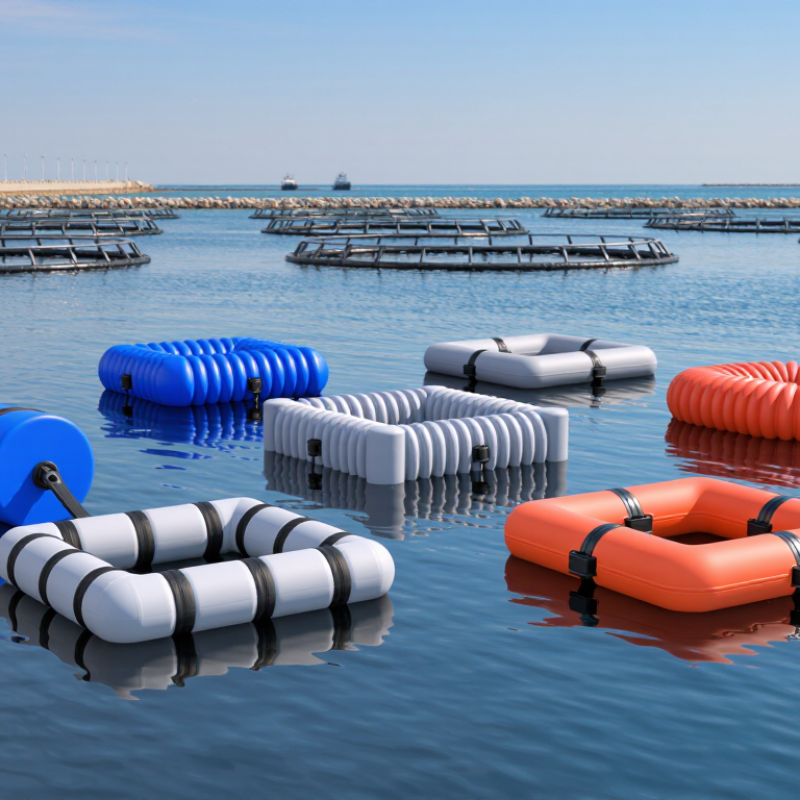
What HDPE Floaters Are and How They Work
HDPE floaters are hollow, buoyant modules made from high-density polyethylene. They support docks, walkways, floating platforms, and some aquaculture equipment. Their lift comes from displacing water: as a floater sits lower under load, it pushes aside more water until buoyancy balances the weight. Simple physics. Sealed chambers help keep water out, while molded ribs can add stiffness. UV-resistant additives may slow sun damage, but they do not make plastic immune to years of exposure, abrasion, or impact.
For buyers, shape and connection details matter as much as material. A dock assembled with pins or bolts needs compatible edges and secure attachment points; loose joints can shift under waves. Check the stated load capacity, wall thickness, dimensions, and any test conditions behind the rating. Loads are rarely spread perfectly evenly. A person standing at one corner can create a different stress than evenly placed cargo. Inspect samples for thin spots, rough seams, or weak-looking fittings. A float may look robust and still perform poorly if its rating, installation, or maintenance assumptions do not match the site.
HDPE Floater Buoyancy: Theoretical Capacity by Displacement Volume
A floater’s displacement determines how much water it can displace when fully submerged.
Values are theoretical gross buoyancy, calculated using a seawater density of 1,025 kg/m³ (about 1.025 kg of displaced seawater per liter). They do not represent usable payload: subtract the floater’s own weight and allow for freeboard, loading, and safety requirements.
Key Criteria for Choosing HDPE Floaters in 2026
Choosing HDPE floaters starts with the real load, not the catalogue’s largest buoyancy figure. Include people, equipment, waves, and water absorbed or trapped during use. The Plastics Pipe Institute’s Handbook of PE Pipe reports HDPE density around 0.941–0.965 g/cm³. In theory, that is only about 35–59 kilograms of buoyancy per cubic metre of solid resin in freshwater. That figure is not a floater’s safe working capacity; shape, wall thickness, and reserve buoyancy change the result.
Small details matter.
Check material grade, wall thickness, weld quality, and UV-weathering evidence. Ask suppliers for test records, including relevant tensile and accelerated-weathering results, rather than relying on “UV-resistant” wording alone. Specify freshwater or seawater, temperature range, expected impact, and anchoring method. Salt spray and repeated loading can expose weak joints before the float body fails. A practical comparison uses load ratings at the same operating conditions, with a stated safety margin. Do not assume a thicker shell is automatically better; it may add weight without solving poor welds or unstable geometry. Review the installation details, too. A sound floater can still perform poorly when spacing or mooring is wrong.
Seven HDPE Floater Options for Global Buyers
Global buyers comparing HDPE floaters in 2026 can start with the job, not the shape.
Solid cylindrical floats suit marker lines and simple buoyancy needs. Hollow pipe floats offer a lightweight option for booms or temporary barriers. Modular dock cubes make platforms easy to extend or repair. Rotomolded pontoons carry larger loads, but wall thickness and internal supports matter. Small details matter. Ask for load ratings, UV-stabilization information, and test conditions—not just a claimed capacity.
Three other options cover more specialized work. Net-cage collars provide flotation around aquaculture enclosures; inspect joints and attachment points for wear. Cable floats support submerged lines at planned intervals, while compact marker buoys improve visibility near work areas. No option is perfect. Salt, sunlight, impact, and repeated loading can shorten service life, even when the polymer is suitable. The OECD’s Global Plastics Outlook reports that 460 million tonnes of plastics were used worldwide in 2019, with 353 million tonnes of plastic waste generated. That wider material footprint makes repairability and end-of-life handling worth checking alongside price. Compare buoyancy at the intended water temperature, connection design, and replacement-part availability. A neat sample may not reveal weak seams. Request drawings and documented test results before ordering.
Matching Floater Designs to Marine and Aquaculture Uses
HDPE floaters serve different jobs, so match their shape and buoyancy to the working conditions. In sheltered fish farms, modular square or rectangular floats can support walkways and net pens while leaving space for feeding and inspection. Check the platform’s rated load, connection points, and resistance to repeated impacts. A float that sits too low under staff and equipment may take on spray and become harder to use.
For exposed marine sites, larger enclosed floats with reinforced attachment points can help handle wave movement and mooring loads. Rounded edges may reduce snagging on ropes, while textured surfaces improve footing when wet. Look closely at wall thickness and internal supports; appearance alone tells little about service life. The trade-off is real. Heavier units can be harder to transport and install.
Aquaculture buyers should also consider cleaning access, water flow, and how replacement sections connect. Smooth surfaces can make routine washing easier, but joints and hollow spaces still need inspection. Ask suppliers for buoyancy and load-test documentation, then compare it with the intended layout and local operating conditions. Those figures matter. Field conditions can differ from a neat test setup, and even a well-matched floater needs regular checks.
Global Buying Factors: Standards, Shipping, and Supplier Support
For global buyers, choosing HDPE floaters starts with matching specifications to the waterway and operating load. Ask for buoyancy data, wall thickness, resin details, and documented test methods. Standards vary by market and project, so confirm which requirements apply before comparing quotations. A certificate without a clear scope may not answer the important question.
Details matter. Request drawings that show connection points, dimensions, and allowable loading. For outdoor use, ask how the material’s UV resistance is assessed and whether the supplier can provide relevant test records. These checks help buyers compare products on more than price. Still, paperwork can be inconsistent; request clarification when units, test conditions, or document dates are unclear.
Shipping needs equal attention. Large floaters can occupy substantial container space, so confirm packed dimensions, loading plans, and delivery terms early. Ask whether accessories, spare parts, and installation guidance can ship together. A responsive supplier should provide realistic lead times and answer technical questions after delivery, not only before payment. On a tight schedule, even a small drawing revision can cause delays.




