

Choosing the right Iron Inductor supplier in China takes more than comparing prices. Global buyers need components that match their electrical, mechanical, and production requirements. A small mismatch in inductance or rated current can affect performance after installation. Details matter.
A useful supplier review starts with the datasheet. Check inductance range, tolerance, saturation current, operating temperature, and dimensions against your design. Ask how each value is tested and whether reports relate to the actual production batch. A sample can reveal practical issues: lead spacing, coating quality, winding consistency, or fit inside a finished assembly. These details are easy to overlook.
Production capacity also deserves careful discussion. Confirm minimum order quantities, sample lead times, packaging, and the process for handling design changes. For repeat orders, traceable batch records and clear inspection criteria can reduce uncertainty. Request relevant quality documentation, but verify its scope and validity rather than relying on a logo or broad claim. Not every factory is the right factory.
Communication is part of the evaluation. Can the supplier explain a tolerance, flag a risky specification, and respond clearly when requirements change? Ask for evidence before treating any supplier as the best choice. Price still matters, of course, but it should be weighed against consistency, support, and delivery performance. A spreadsheet helps. It cannot tell the whole story. Some buyers learn this only after an unsuitable sample arrives. Compare documented capabilities with your own testing, then choose a partner whose limits are as clear as its strengths.
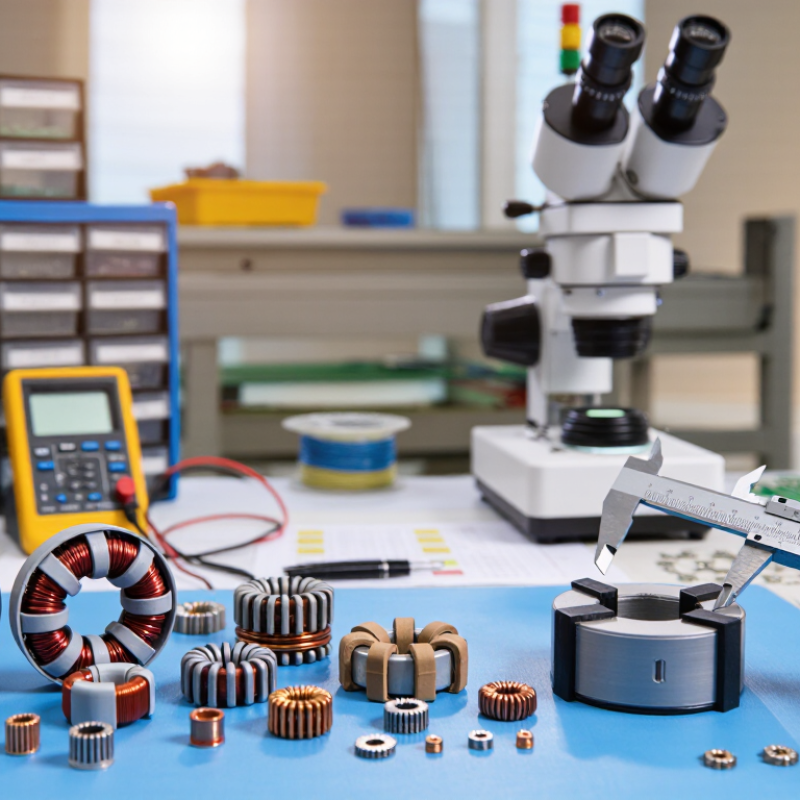
China Best Iron Inductor Supplier for Global Buyers?
What Iron Inductors Are and How They Function
An iron inductor is a coil wound around an iron-based core. When current flows through its turns, it creates a magnetic field and stores energy. The inductor resists rapid changes in current, helping smooth power in converters, filters, and motor drives. In a switching converter, current rises while the switch is on and falls when energy moves to the next circuit stage. The core matters: its material and shape affect inductance, losses, and saturation behavior.
Demand for efficient power electronics is growing. The International Energy Agency’s Global EV Outlook 2024 reports that nearly 14 million electric cars were sold in 2023, about 18% of global car sales. This is useful context, not a direct measure of inductor demand. For design teams, the practical checks are inductance under operating current, winding resistance, temperature rise, and ripple-current rating. A core nearing saturation can lose inductance quickly. Small details matter.
Tips: Match the inductor’s rated current to real operating conditions, not just the circuit’s average current. Check heat after sustained operation. A datasheet helps, but it cannot replace testing in the finished device.
| Dimension | Typical Information | How It Affects Function | What Buyers Should Verify |
|---|---|---|---|
| What an iron inductor is | A coil wound around an iron-based magnetic core, commonly made from insulated iron powder or laminated electrical steel. | The core concentrates magnetic flux, allowing the coil to provide inductance in a compact form. | Confirm the core material and construction rather than relying on the general term “iron core.” |
| Operating principle | A changing current creates a changing magnetic field; the inductor stores energy in that field and resists rapid changes in current. | In switching circuits, it can smooth current and transfer or store energy between switching intervals. | Check inductance at the relevant frequency and DC bias, not only at a small-signal test condition. |
| Iron-powder core | Powder particles are electrically insulated from one another and form a distributed magnetic gap. Effective permeability varies by grade; values around 10–100 are common for many materials. | The distributed gap can support energy storage and help the inductor retain useful inductance under DC bias. | Request the specific material grade, bias curves, core-loss data, and operating-temperature limits. |
| Carbonyl iron powder | A fine iron-powder material used in some RF and high-frequency magnetic components; permeability depends on grade and processing. | Can be used in RF inductors and chokes, where frequency-dependent core loss is an important design factor. | Ask for loss or impedance data at the intended frequency; do not assume all iron powders have the same high-frequency performance. |
| Laminated electrical steel | Thin insulated steel sheets are stacked to limit circulating eddy currents. Typical saturation flux density is approximately 1.5–2.0 T, depending on grade and conditions. | Often used in low-frequency power magnetic applications; lamination helps reduce eddy-current loss compared with a solid steel core. | Confirm the lamination thickness, material grade, frequency range, and loss data for the intended operating point. |
| Inductance (L) | Specified in henries, commonly millihenries (mH) or microhenries (µH) for practical components. The required value depends on the circuit. | Together with frequency and circuit conditions, inductance affects current ripple, impedance, and energy storage. | Specify the test frequency, test level, tolerance, and whether the value must be maintained under DC bias. |
| Current rating and saturation | Current ratings are application- and design-dependent. A datasheet may define a saturation current by a stated inductance drop and a thermal current by a stated temperature rise. | Excess current can reduce inductance as the core approaches saturation; winding losses can also cause overheating. | Compare the stated test definitions, DC-bias curves, ambient temperature, and cooling conditions. |
| DC resistance (DCR) | The winding’s resistance to direct current, normally stated in ohms or milliohms at a specified temperature. | DCR contributes to copper loss and voltage drop; winding resistance generally increases as temperature rises. | Check the maximum DCR, measurement temperature, wire construction, and expected temperature rise. |
| Core loss and operating frequency | Core loss depends on material, frequency, flux swing, temperature, and waveform; there is no single frequency range suitable for every iron-core design. | Excessive core loss produces heat and lowers efficiency, especially when frequency or flux swing is high. | Request loss data or validated thermal results at conditions close to the actual application. |
| Quality and export documentation | Relevant information may include a controlled datasheet, dimensional drawing, inspection criteria, material declarations, and applicable compliance documents. | Clear specifications and traceable inspection records help maintain consistency across production lots and markets. | Confirm the exact part specification, change-control process, sample validation, packaging, and destination-market requirements. |
Values are representative guidance only. Actual performance varies with core composition, geometry, winding, temperature, frequency, and test method; use the component datasheet and application measurements for final selection.


