
Welcome to Worldia, we have over 25 years of expertise.

How to Choose a Bathtub Floor Faucet

A Bathtub Floor Faucet is more than a decorative fixture. It determines how water reaches the tub, how comfortably you can fill it, and how the bathroom feels every day. Because it stands beside the tub rather than emerging from the wall, its location, height, and reach deserve careful attention. A small mismatch can leave the spout awkwardly positioned or make the controls difficult to use.

Industry research offers useful context. The National Kitchen & Bath Association’s 2024 Kitchen & Bath Market Outlook examines ongoing investment in residential renovations, while Houzz’s 2024 U.S. Bathroom Trends Study tracks choices homeowners make during bathroom projects. These reports do not rank floor-mounted tub faucets or identify one universally best model. They do reinforce a practical point: fixtures should be chosen as part of the room, not in isolation. Measure the tub’s rim and faucet-to-tub distance before comparing designs.

Then consider water flow, installation access, finish durability, and the faucet’s compatibility with your plumbing. Check the manufacturer’s technical specifications, including required floor rough-in and spout reach. A polished finish may look striking in a showroom, yet show water spots at home. That matters. So does service access beneath the floor, which is easy to overlook during planning. This guide explains how to weigh those details, compare styles, and choose a Bathtub Floor Faucet that suits both your bathroom and your routine.
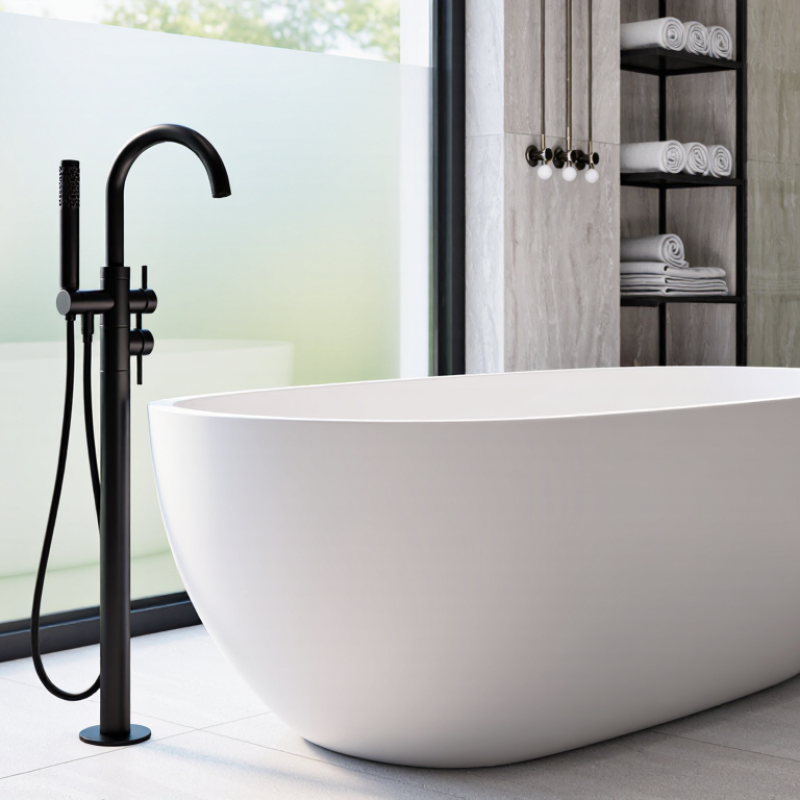
How to Choose a Bathtub Floor Faucet

What a Bathtub Floor Faucet Is and How It Works

A bathtub floor faucet, often called a freestanding tub filler, stands beside the tub rather than attaching to its rim or wall. Hot and cold supply lines run beneath the floor into a secured rough-in fitting. Turning the handle opens valves that regulate and mix the water before it leaves the spout. Some models also divert water to a hand shower. Simple in appearance, but the hidden connections matter.

The U.S. EPA’s WaterSense at Home guide gives 2.5 gallons per minute as the conventional showerhead flow rate. That figure is a useful comparison, not a rating for tub fillers: faucet flow varies by model and water pressure. Check the product’s stated flow rate and estimate filling time against your tub’s capacity. A wide, deep tub can take longer to fill than expected.

Measure the spout’s reach against the tub rim and drain position. Water should fall inside the basin, not splash onto the floor. Before installation, confirm the rough-in height, supply locations, and floor support with a qualified plumber. Tile alone may not provide a secure anchor. One small oversight can mean opening finished flooring later.

Check Bathtub Placement, Plumbing Access, and Faucet Compatibility

How to Choose a Bathtub Floor Faucet

Check Bathtub Placement, Plumbing Access, and Faucet Compatibility

Measure the tub’s final position before choosing a floor-mounted faucet. Leave enough clearance for the spout to reach the basin without splashing onto the floor. Check that the handle and hand shower remain easy to reach from the tub. A faucet that looks centered on a drawing may feel awkward beside a deep tub. Mock up its location with tape. It helps.

Confirm where the hot and cold supply lines run, and whether a plumber can reach them later. Floor-mounted faucets often need a secure in-floor support and accessible connections; finished tile alone is not a dependable anchor. If the tub sits over a slab, ask about routing pipes before ordering. The 2024 Cost vs. Value Report places a midrange bathroom remodel at an average of $25,251 in the United States, a reminder that changing finished plumbing can add substantial project cost. Check the faucet’s rough-in requirements, supply connection size, and specified water pressure against the home’s plumbing. Also confirm spout reach and flow with the tub’s dimensions. Small detail, real consequence. Compatibility is easy to overlook when the finish catches your eye. I would verify the installation sheet with the plumber before the floor is closed.

How to Choose a Bathtub Floor Faucet

Check bathtub placement, plumbing access, and faucet compatibility before installation.

Checklist counts show how many practical items to verify in each area—not a priority score. Confirm fixture-specific dimensions, connections, and pressure requirements with the faucet manufacturer and applicable local codes.

Compare Faucet Styles, Spout Reach, and Handle Configurations

A floor-mounted bathtub faucet can become a striking feature, but its shape should suit the tub and room. Choose a slim, open-spout style for a clean look, or a sturdier profile if you want a more substantial visual presence. Check the faucet’s installation requirements before choosing: these fixtures usually need plumbing access beneath the floor. A beautiful faucet is not useful if its position makes servicing difficult.

Spout reach matters more than appearance alone. Measure from the faucet’s center to the tub’s inner edge, then confirm that the stream will land inside the basin without splashing over the rim. A deep tub or wide rim may need a longer reach. Also check faucet height against the tub; a tall spout can feel elegant, but it may send water noisily into a shallow basin. Small details. They can change the experience.

Handle configuration affects everyday use. Separate hot and cold handles offer precise adjustment, while a single lever is often easier to operate with wet hands. Try the controls’ reach and turning direction against the tub’s placement, especially if the faucet sits near a wall.

Tips: Use painter’s tape to mark the faucet base and spout position beside the tub. Check those measurements with your installer before finalizing the plumbing; I’d recheck them, even when the layout seems obvious.

Evaluate Materials, Finishes, Flow Rate, and Included Components

A floor-mounted tub faucet must handle daily splashes, cleaning, and the bathroom’s humidity. Compare brass, stainless steel, and other listed body materials, then check whether the finish is specified for corrosion resistance. NSF/ANSI/CAN 61 addresses health effects of materials in contact with drinking water; it is a useful reference, though it does not certify every faucet feature. Look for clear compliance information, not vague claims. The drain is a separate purchase surprisingly often.

Flow rate affects how long filling takes. Check the faucet’s rated gallons per minute and compare it with your tub’s usable capacity; a 50-gallon fill at 5 GPM takes about 10 minutes in ideal conditions. Actual filling takes longer if you leave headroom or share the water supply. EPA WaterSense’s 1.5 GPM limit applies to qualifying bathroom sink faucets, not tub fillers, so don’t use it as a tub-faucet benchmark. ASME A112.18.1/CSA B125.1 provides performance requirements for plumbing supply fittings; confirm the product’s stated compliance and flow data.

Read the box contents before comparing prices. A floor faucet may include a hand shower, hose, rough-in valve, trim, or none of these. Check the rough-in depth and mounting plate against the finished floor, especially near radiant heating or plumbing lines. Finishes can look nearly identical online. Order a sample if the match matters. I’d also verify replacement-part availability; it’s easy to overlook until a cartridge needs changing.

How to Choose a Bathtub Floor Faucet - Evaluate Materials, Finishes, Flow Rate, and Included Components

Example Configuration Body Material Finish Typical Flow Rate Components to Check Evaluation Notes
Standard floor-mounted tub filler Solid brass Polished chrome Approximately 4–7 gpm (15–26.5 L/min), depending on the model and water pressure Faucet body, hand shower, shower hose, mounting hardware, and rough-in connection Brass is a commonly used, corrosion-resistant material for faucet bodies. Chrome is easy to clean, but water spots and fingerprints may be visible.
Minimalist floor-mounted tub filler Stainless steel Brushed stainless steel Approximately 4–6 gpm (15–23 L/min), depending on the model and water pressure Faucet body, hand shower, hose, floor-mount base, and installation instructions Confirm the exact stainless-steel grade and construction in the product specifications. A brushed surface can make minor marks less noticeable than a polished surface.
Decorative floor-mounted tub filler Brass body with plated surface Brushed nickel Approximately 4–7 gpm (15–26.5 L/min), depending on the model and water pressure Faucet body, hand shower, hose, supply connections, and mounting hardware Check the manufacturer’s cleaning guidance for the finish. Avoid abrasive cleaners, which can damage many plated or coated surfaces.
Low-flow floor-mounted tub filler Brass or stainless-steel body Chrome, brushed nickel, or another specified finish Often around 2–4 gpm (7.6–15 L/min); verify the rated figure for the specific model Faucet body, hand shower if included, hose, mounting hardware, and any specified flow-control components A lower flow rate may take longer to fill a bathtub. Compare the rated flow with the tub’s capacity and the home’s available water pressure.
Floor-mounted tub filler with separate rough-in kit Visible faucet material varies; rough-in components are typically metal or specified engineered materials Finish selected for the visible faucet Use the faucet’s published rating; flow varies with pressure and installation Check whether the rough-in valve, supply lines, floor flange, mounting hardware, and hand shower are sold separately Confirm the required rough-in kit and floor access before purchase. Do not assume installation parts are included just because they appear in product images.

Note: Flow-rate figures are general examples, not guaranteed specifications. Actual flow depends on the faucet design, water pressure, plumbing, and any flow restrictor. Check the product’s published rating and local plumbing requirements before buying.

Review Installation Requirements and Long-Term Maintenance Needs

How to Choose a Bathtub Floor Faucet

A floor-mounted faucet needs more planning than a wall-mounted one. Check the floor structure, water-supply route, and drain position before choosing a model. The faucet’s rough-in dimensions must match the tub’s placement, with enough clearance for the spout to reach safely over the rim. On a concrete slab, moving pipes may require extra work. I would not assume the existing plumbing can be reused without an inspection. Small details matter.

Tips: Ask a licensed plumber to confirm the pipe locations and floor support. Keep shutoff valves and connections accessible, perhaps through a nearby service panel. Before installation, mark the faucet’s footprint with tape and check that it will not obstruct walking space or cleaning.

Long-term care depends partly on water quality and finish. Wipe the faucet dry after bathing to limit mineral spots, and clean it with a soft cloth and mild soap. Avoid abrasive pads, which can dull surfaces. Every few months, inspect the base and visible connections for moisture, loose fittings, or discoloration. A tiny drip can be easy to miss. Access for repairs is worth considering now, even if it makes the installation less visually seamless.

Hi! What is your idea today?
WORLDIA 8618618272087
Nina +86 15631662072
google-site-verification=0STkOZEvYuoDp-D40AVfMUk--CzM2AsZv24S6ISPdmk