
Welcome to Worldia, we have over 25 years of expertise.

How to Choose a French Style Wall Light

A French Style Wall Light can bring the quiet elegance of a Parisian apartment to a hallway, bedroom, or dining room. Yet its charm depends on more than a curved arm or antique-brass finish. Scale, placement, brightness, and the room’s existing details all matter. A petite sconce may disappear beside a broad fireplace, while an ornate fixture can crowd a narrow corridor. Small choices change the whole effect.

Lighting designer Sally Storey’s approach can be paraphrased this way: “Choose lighting for the atmosphere and task it must serve, not appearance alone.” Treat that as a useful principle, not a one-size-fits-all rule. Consider where the light will fall: beside a mirror, a shaded bulb may soften the face; above a reading chair, a directed beam may be more practical. Check the wall space, too. A fixture that looks delicate online can feel surprisingly large once installed.

This guide will help you compare silhouettes, finishes, light output, and placement before you buy. It will also point out details worth checking, including bulb compatibility and whether the fitting suits your room’s conditions. There is no perfect formula. Personal taste can lead you slightly off course, and that is worth reflecting on. A thoughtful choice should feel beautiful at first glance—and comfortable to live with every evening.
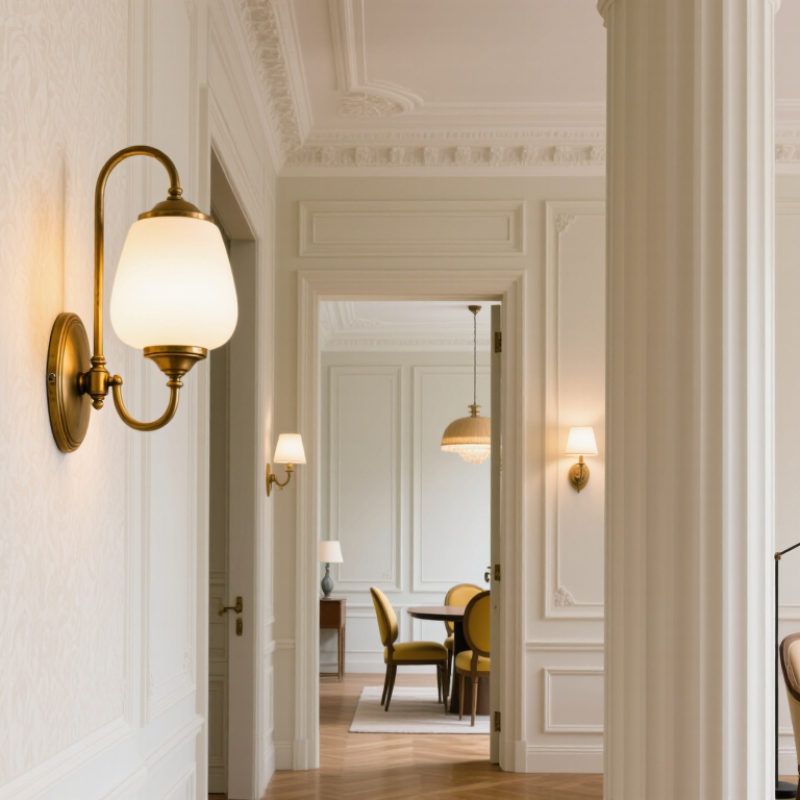
How to Choose a French Style Wall Light

Understanding the Key Features of French-Style Wall Lights

French-style wall lights are defined by shape and finish, not ornament alone. Look for swept arms, candle-shaped sockets, small pleated shades, and softly aged brass or iron. These details suit plaster walls, paneled rooms, and warm neutral palettes. Check the backplate and arm depth against your wall space; a broad fixture can feel crowded beside a narrow mirror. Finish matters, too. A polished surface looks formal, while a subdued patina feels more relaxed.

Light quality is just as important as appearance. Choose a dimmable, warm-white lamp for bedrooms and dining areas, and confirm that the fixture accepts the bulb type you need. The U.S. Department of Energy reports that LEDs use at least 75% less energy and can last up to 25 times longer than incandescent bulbs. That makes an LED-compatible fitting a practical choice, though not every decorative socket supports every lamp. Check the product’s specifications before buying. Also consider the room: a fabric shade softens light, but may not provide enough brightness for reading.

Tips: Hold a paper outline of the fixture against the wall before ordering. Measure from the floor and nearby furniture, then check the mounting height. Small details are easy to overlook; I would also verify whether the finish is intentionally aged or simply uneven.

How to Choose a French Style Wall Light - Understanding the Key Features of French-Style Wall Lights

Feature What to Look For Common Options Practical Guidance
Silhouette Graceful curves, balanced proportions, and decorative detailing. Candle-style arms, curved stems, scrolling arms, or a simple fabric-shade form. Choose a shape that suits the room’s scale; ornate designs often work best where they have visual space.
Materials A sturdy metal frame, with glass or fabric elements where appropriate. Common choices include brass, iron, steel, glass, and textile shades. Check the product specifications for material composition and cleaning instructions; finishes can vary in durability.
Finish and color A finish that complements nearby hardware and the room’s color palette. Aged or polished brass, bronze, painted metal, and muted neutral shades. Finish names are not standardized; compare product photos and descriptions rather than relying on the label alone.
Shade and light direction A shade or candle-style lamping that gives the desired balance of ambient and task light. Fabric shades soften light; glass shades can spread light; exposed candle-style bulbs create a more decorative effect. Check whether the light is directed upward, downward, or both, and consider glare in the intended position.
Size and projection Overall height, width, and distance the fixture extends from the wall. Compact single-arm fixtures suit tighter spaces; larger multi-arm designs need more wall area. Measure the available wall space and nearby doors, furniture, or walkways before choosing a fixture.
Bulb and dimming Compatible bulb base, maximum wattage, brightness, and dimmer support. Many fixtures accept LED bulbs, but base type and permitted bulb size depend on the fixture. Follow the fixture’s label or instructions. For dimming, verify that both the bulb and dimmer are compatible.
Mounting and wiring Whether the fixture is designed for hardwiring or plug-in use, and what mounting hardware is included. Hardwired and plug-in wall lights are both available. Check local electrical requirements and the installation instructions; use a qualified electrician when required.
Room suitability A design and rating suitable for the fixture’s location. Living rooms, bedrooms, hallways, and bathrooms may require different fixture ratings. For bathrooms or damp locations, check the fixture’s listed location rating and applicable local code.

Specifications vary by fixture. Confirm dimensions, electrical requirements, bulb compatibility, and location ratings in the product documentation before purchase.

Assessing Room Placement and Lighting Needs

How to Choose a French Style Wall Light

Assessing Room Placement and Lighting Needs

Placement matters as much as the fixture’s shape. In a narrow hallway, mount a French-style wall light where its shade will not catch shoulders or cast a harsh glare into nearby rooms. In a living room, place it beside a reading chair or above a console, checking that the beam reaches the useful surface. The IES Lighting Handbook, 10th edition, treats ambient and task lighting as different needs; one wall light rarely serves both equally well. That distinction is easy to overlook.

Match brightness to the activity, then test the effect at night. IES illuminance guidance commonly puts relaxed living areas near 10 foot-candles, while reading tasks may need roughly 30–50 foot-candles at the page. These are starting points, not guarantees: wall color, shade opacity, and mounting height all change the result. The U.S. Department of Energy also advises comparing bulbs by lumens, not watts; lumens describe light output, while watts describe energy use. A small, shaded fixture may look elegant but leave a book in shadow. Check the actual reading spot, and adjust the bulb or add a second light if needed. I still find that a quick daytime glance can mislead; assess the fixture after dusk, when reflections and dark corners become obvious.

Choosing a Shape, Material, and Finish

A French-style wall light is shaped by proportion, not ornament alone. Look for a curved arm, a gently tapered shade, or a compact lantern form. Match the silhouette to the wall: a narrow corridor often suits a shallow fixture, while a bedside light can carry more visual weight. Small rooms need restraint. Measure the backplate and projection before buying; a pretty fixture can feel awkward when it crowds a doorway. Slightly imperfect symmetry may add charm, but it should not obstruct switches or artwork.

Material changes both mood and maintenance. Aged brass brings warmth, while dark iron gives a sharper outline. Opal glass softens glare; clear glass exposes the bulb and dust. Think about the room’s existing metals, but do not force an exact match. That can look staged. Finish affects upkeep, too: polished surfaces show fingerprints more readily than brushed ones. For the light source, the U.S. Department of Energy reports that LEDs use at least 75 percent less energy and last up to 25 times longer than incandescent lighting. ENERGY STAR gives similar guidance for certified LED bulbs. Choose a compatible dimmable bulb, then check the fixture’s stated limits. It is easy to focus on the brass sample and forget the actual light.

Selecting the Right Size and Light Output

Measure the wall area before choosing a French-style sconce; ornate arms and shades often project farther than photos suggest. On a narrow hallway wall, a broad backplate can feel crowded, even when the shade looks small. Check the fixture’s height, width, and projection against nearby trim, artwork, or a mirror. For a pair beside a bed or vanity, mark both positions with painter’s tape and view them from across the room. Stand back.

Use lumens, not wattage, to compare brightness. A bedside reading light often works around 200–400 lumens, though shade opacity and aiming affect how much light reaches the page. For a general glow, choose softer output; a dimmer adds flexibility when the fixture serves both reading and relaxed evenings. Warm 2700–3000 K light usually flatters painted walls and aged finishes, while cooler light can feel sharper. Check whether the bulb is replaceable and dimmer-compatible, and confirm the fitting suits your wiring. I still find that paper measurements can mislead when a curved arm sits close to a door or mirror. That detail is easy to overlook.

Checking Installation Requirements and Bulb Compatibility

Before choosing a French-style wall light, check the wall box, mounting plate, and available wiring. The fixture should cover the box cleanly, sit securely against the wall, and leave enough room for the shade. Turn off power at the breaker before inspecting existing wiring. If the wiring is unclear or the wall needs a new connection, ask a qualified electrician. Small details matter. A crooked plate can make even an elegant fixture look unfinished.

Match the bulb to the fixture’s socket, voltage, shape, and maximum wattage. Check whether the shade or enclosure requires a specific bulb type, and confirm that the bulb works with your dimmer. An LED bulb that fits physically may still flicker on an incompatible dimmer. The U.S. Department of Energy’s Energy Saver guidance says LEDs use at least 75% less energy and can last up to 25 times longer than incandescent bulbs. That comparison is useful, but it does not replace checking the fixture label. I would measure the shade opening before buying; it is an easy step to miss, and bulb dimensions are not always obvious in product listings.

Hi! What is your idea today?
WORLDIA 8618618272087
Nina +86 15631662072
google-site-verification=0STkOZEvYuoDp-D40AVfMUk--CzM2AsZv24S6ISPdmk