What is a Coaxial Attenuator and How Does It Work?
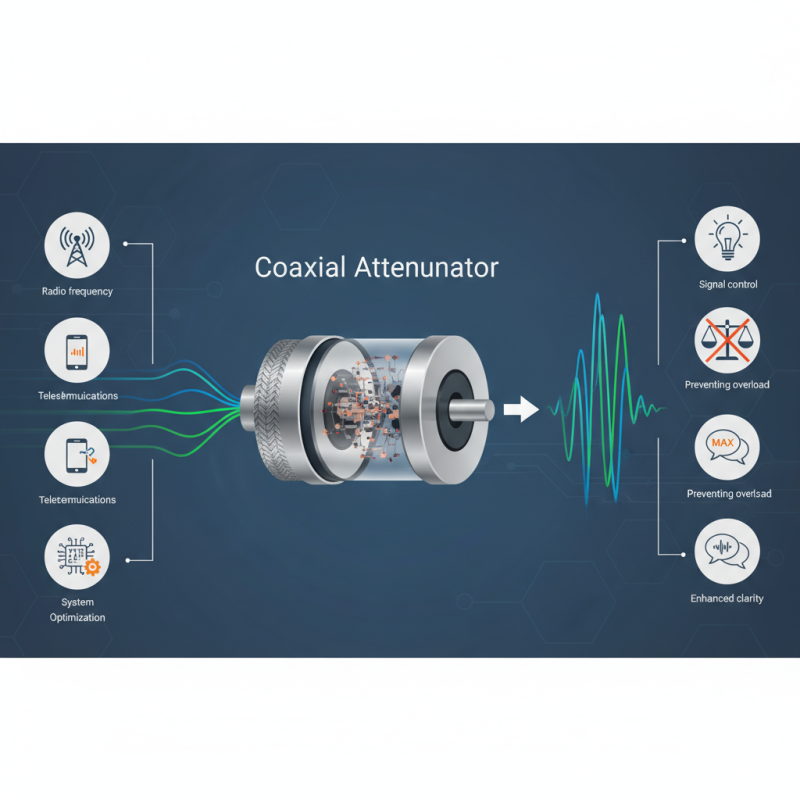
A Coaxial Attenuator plays a crucial role in radio frequency applications. It helps to control signal strength, ensuring optimal performance. This device reduces the power of a signal without distorting its waveform.
In telecommunications, a coaxial attenuator is essential. It allows engineers to manage volume levels in various systems. This capability prevents signal overload. Proper use can enhance the clarity of communication systems. However, using this device incorrectly may lead to undesirable outcomes.
A coaxial attenuator consists of resistive components housed in a compact design. Despite its simplicity, choosing the right attenuator requires careful analysis. Different applications demand specific types for efficient operation. Understanding these nuances is vital for effective deployment.
Definition and Purpose of Coaxial Attenuators
Coaxial attenuators play a vital role in various communication systems. They are used to reduce signal strength without distorting the signal. This can be crucial in environments where signal levels are too high, risking equipment damage. Effective attenuation ensures optimal performance in audio, video, and data transmission applications.
The essence of a coaxial attenuator lies in its construction. Typically, it consists of resistive components that dissipate excess power. By absorbing some of the signal, the attenuator allows the remaining signal to pass through. This is especially helpful in complex systems where maintaining signal integrity is essential. However, imperfect materials may lead to unwanted reflections. Engineers must be mindful of these factors to avoid issues in signal transmission.
Understanding how a coaxial attenuator functions is essential for efficiency. Depending on the application, choosing the right level of attenuation is crucial. Over-attenuation might weaken the signal too much. Under-attenuation can result in equipment overload. Balancing these aspects requires careful measurement and consideration, often leading to further analysis and adjustment.
Fundamental Principles of Signal Attenuation in Coaxial Systems
In coaxial systems, signal attenuation is a critical factor. It describes the reduction of signal strength as it travels through a medium. This phenomenon occurs due to resistance in the cable, dielectric losses, and other factors. These elements can lead to weaker signals, resulting in potential data loss.
Understanding how coaxial attenuators work is fascinating. An attenuator is essentially a passive device that reduces signal amplitude without reflection. It uses resistive networks to achieve this attenuation. Different configurations can provide various levels of signal reduction. The key lies in choosing the right design for your application.
Not all attenuators are created equal. The effectiveness of an attenuator depends on frequency, input power, and the specific application. Real-world factors, like environmental conditions, can also affect performance. Sometimes, the desired attenuation cannot be achieved without compromising quality. Users must test their systems thoroughly, considering these variables for optimal results.
Coaxial Attenuator Signal Attenuation Levels
This bar chart illustrates the signal attenuation levels in a typical coaxial cable system at different frequencies. Each bar represents a different frequency, showcasing how signal strength decreases over distance due to attenuation.
Types of Coaxial Attenuators and Their Applications
Coaxial attenuators come in various types, each serving specific applications. The most common ones include fixed, variable, and step attenuators. Fixed attenuators offer a set level of attenuation and are used where consistent signal reduction is crucial. Their simplicity makes them popular in many setups. However, they lack flexibility. Variable attenuators allow for adjustable signal strength. This feature is beneficial in experiments where signal levels may change. Yet, they can be more complex to use.
Step attenuators provide a middle ground. They can adjust levels in defined steps, making them versatile for different tasks. Many audio and RF applications rely on step attenuators to manage signals effectively. Despite their effectiveness, choosing the right type can be challenging. Users must assess their needs carefully. Sometimes, a simple adjustable option may be missed for complicated designs. Each type of attenuator has its own strengths and weaknesses, making thoughtful selection vital.
Working Mechanism of Coaxial Attenuators Explained
Coaxial attenuators are essential components in RF (radio frequency) systems. Their primary role is to reduce signal power without significantly distorting the waveform. This function is crucial in various applications, from telecommunications to broadcasting. Reports indicate that the global RF components market is expected to reach $36 billion by 2025, highlighting the growing importance of attenuators.
The working mechanism of coaxial attenuators involves a simple yet effective design. They utilize resistive elements to dissipate energy. Signals enter the attenuator through a coaxial connector, encountering resistors that split and reduce the signal's amplitude. Typically, these devices offer various attenuation levels, often measured in decibels (dB). A common specification is 3 dB, which halves the power. However, users should be mindful. Not all attenuators behave uniformly across different frequencies. Some may introduce unwanted reflections or noise.
In practical applications, ensuring accurate attenuation is vital. Miscalculations can lead to signal degradation. For instance, a misconfigured attenuator might lead to a 10% loss in signal integrity. This can affect the overall performance of a system, especially in high-frequency applications. Engineers must always account for specific use cases. Testing and calibration remain crucial to achieving optimal performance in complex RF networks.
Selecting the Right Coaxial Attenuator for Your Needs
Selecting the right coaxial attenuator can be quite a task. It requires understanding both your setup and the specifications of the attenuator itself. Various factors come into play, such as frequency range, power handling, and attenuation level. A good match ensures minimal signal loss and optimal performance.
Carefully check specifications before buying. Not every attenuator fits every system. Consider the type of connectors you need. Think about where you will use it. Will it be in a lab or a field? Each environment calls for different durability and size. It’s important to measure the space available for installation.
Also, don’t forget about your signal's power. An attenuator needs to handle the power levels in your system. If you choose one that can't, it could fail. Performance may suffer as a result. Take your time to research and compare different options. Sometimes, the cheapest option isn’t the best one. It can help if you write down pros and cons for each choice.