
Global buyers are evaluating more than a rail cart’s top speed. They need dependable movement, clear safety controls, and support that lasts beyond installation. A Self Driven Rail Cart can reduce repetitive transfers between production cells, warehouses, and loading points. Yet the right choice depends on the route, payload, floor conditions, and existing control systems.
The wider automation market provides useful context, but not a direct measure of rail-cart demand. The International Federation of Robotics’ World Robotics 2024 report recorded 541,302 industrial robots installed worldwide in 2023, with 4,281,585 operating across factories. These figures show the scale of industrial automation, not sales of self-driven rail carts. That distinction matters. IFR President Marina Bill described robots as “a key technology for the competitiveness of manufacturing industries.” For buyers, competitiveness still depends on practical details: Can the cart stop accurately at a transfer point? Can operators inspect its sensors easily? What happens when a route changes?
This guide introduces ten manufacturers for global buyers and offers a structured starting point for comparison. It considers navigation methods, rated payloads, operating environments, integration options, service coverage, and documented safety features. Specifications should be checked against each supplier’s latest technical documents; product configurations can vary by region and project. A polished brochure is not a factory trial. Buyers should request route-specific testing, clear maintenance plans, and references from comparable installations. Small details count. A narrow aisle, a dusty rail, or a delayed spare part can change the economics. No shortlist can replace site assessment, and this one has limits.
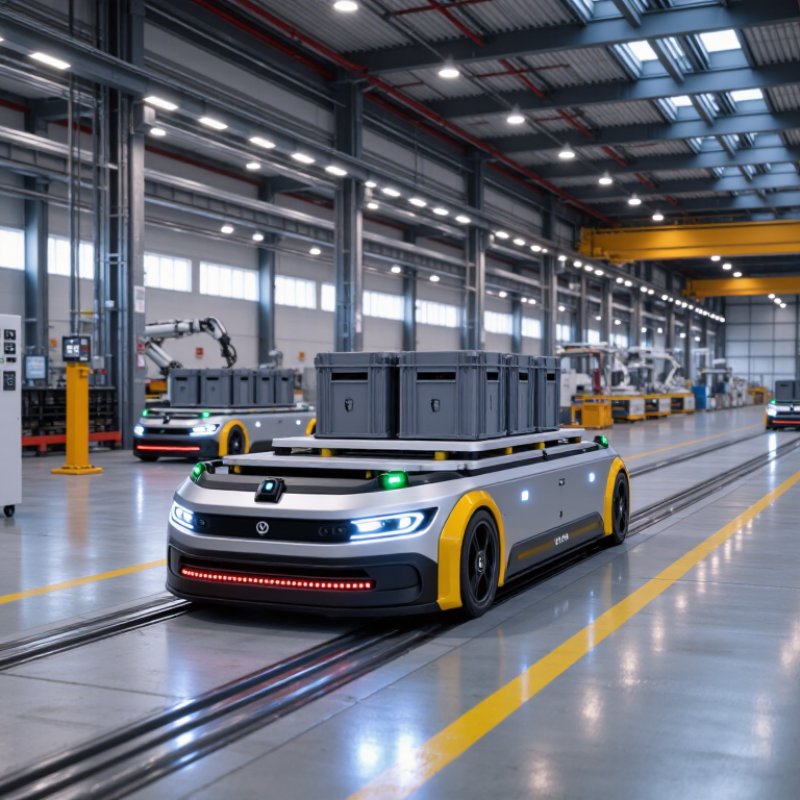
A self-driven rail cart is a powered carrier that moves along fixed rails with limited or no continuous manual pushing. Its wheels follow the track, while an onboard motor supplies traction. This differs from a hand-pulled trolley, but it does not mean the cart can operate safely without planning. The route, load, and stopping points still matter. Small details matter.
A typical system uses a battery, drive controller, braking components, and a control interface. Depending on the installation, workers may start and guide the cart from onboard controls, a handheld unit, or a programmed system. Sensors can detect obstacles or help the cart stop at set locations. Their capabilities vary, so buyers should check what each sensor actually monitors. A cart on a straight, clean track behaves differently from one facing curves, joints, dust, or changing floor conditions near loading areas.
In use, the cart carries materials between workstations, storage areas, or loading points. A practical assessment includes maximum payload, travel speed, rail gauge, curve radius, charging needs, and emergency stopping behavior. Request test results under conditions similar to the intended site, not just ideal demonstrations. Specifications can look tidy on paper. Real operations are messier, and a small mismatch between track layout and cart design may cause delays or repeated adjustments.
Self-driven rail carts are commonly grouped by power source and task. Battery-powered models suit indoor routes where low noise and controlled emissions matter. Diesel-powered versions may serve outdoor yards or long-duty cycles, though exhaust and ventilation need attention.
Transfer carts move pallets, dies, or machine parts between fixed stations. Coil and mold carriers use shaped supports to steady specialized loads.
Details matter.
Rail-guided carts follow a fixed track, which helps keep travel predictable around production lines. Their load capacity, deck size, turning arrangement, and stopping accuracy should match the actual route and cargo. Some use onboard batteries with charging points near work areas; others draw power through external systems.
Controls may include pendant operation, onboard driving, or programmed movement. Safety features often include emergency stops, warning lights, obstacle sensors, and speed limits. These need regular checks, not just a place on the specification sheet.
For global buyers, confirm rail gauge, floor conditions, duty cycle, and access for maintenance before comparing models. A cart that handles the maximum load may still be unsuitable if its deck is too high or its turning space is too wide.
Ask for documented load tests and clear service instructions. One point is easy to overlook: real routes are rarely as tidy as drawings. A narrow aisle or uneven joint can change daily performance.
For global projects, evaluate a self-driven rail cart against the real route, not just its headline payload. Measure rail gauge, curves, gradients, floor transitions, and stopping distance. Ask for rated capacity at your actual travel speed and duty cycle. A cart carrying steel coils across a hot shop needs different wheels, braking, and protection from one moving boxed parts indoors. Confirm battery runtime under load, charging method, obstacle detection, and how the controls connect with existing equipment. The International Federation of Robotics reported 541,302 industrial robot installations in 2023 in World Robotics 2024. That figure signals a highly automated industrial landscape, but it is not a rail-cart market statistic.
Request test records, drawings, maintenance intervals, spare-parts lead times, and references from comparable operating conditions. Check whether the supplier can support commissioning across borders and provide clear operator training. Review safety requirements with a qualified local engineer; ISO 3691-4 may be relevant to driverless industrial vehicles, but its applicability depends on the system design. A tidy specification sheet cannot replace a loaded route trial. Small details matter.
Tips: Ask the manufacturer to demonstrate a full-load stop on your rail layout. Record stopping distance, wheel temperature, and battery use. Then compare results with the proposal. One weakness in this process: a short trial may miss wear that appears after months of shifts.
Suggested evaluation weights for comparing suppliers. These are buyer-planning guidelines, not measured market statistics or manufacturer rankings.
How to use this chart: Prioritize load capacity, safety, and compliance with the standards required at the project site. Verify claims with technical documents, test records, references, and a clear service plan before making a supplier decision.
The ten manufacturer profiles should make practical differences easy to compare, not just present polished product photos. Look for rated payload, rail gauge, travel speed, and operating method. A cart moving steel coils indoors may need a different frame and drive system from one carrying tools along a maintenance track. Check whether the quoted capacity includes the cart itself. That detail is easy to miss. Fit matters.
A useful overview also identifies control options, braking, emergency stops, battery type, charging time, and available track layouts. Ask how the cart behaves on slopes, at rail joints, and during repeated shifts. Request drawings, duty-cycle guidance, and clear installation requirements. These details help buyers judge whether a standard unit can work or whether customization is likely. Support matters, too: confirm spare-parts availability, service response, and operator training before comparing prices. Specifications can look complete while leaving real operating conditions unclear. A careful shortlist should flag missing information rather than assume every manufacturer measures performance the same way. Some comparisons will remain imperfect until suppliers answer the same technical questions.
An anonymized buyer-comparison guide. The entries below cover product and supplier capabilities to verify; they are not named or ranked manufacturers. Specifications vary by application and should be confirmed with each supplier.
| No. | Comparison Dimension | Relevant Product Fact | What Global Buyers Should Verify |
|---|---|---|---|
| 1 | Rated payload | Payload capacity depends on the cart structure, wheel and rail design, drive system, and operating conditions; there is no single capacity that applies to all rail carts. | Request the rated load, load distribution assumptions, and any limits for gradients, curves, or duty cycle. |
| 2 | Rail and track compatibility | Rail gauge, rail profile, wheel geometry, curve radius, and track condition all affect cart fit and operation. | Provide track drawings and confirm gauge, rail profile, minimum curve radius, and allowable track tolerances. |
| 3 | Power source | Self-driven carts may use onboard battery power or a site-supplied power arrangement. The suitable option depends on route length, operating hours, and charging or power infrastructure. | Compare energy source, charging method, operating time per charge, and provisions for battery maintenance or replacement. |
| 4 | Travel speed and control | Operating speed is application-specific and may be limited by payload, route layout, braking performance, and workplace rules. | Ask for loaded and unloaded speed settings, acceleration and stopping behavior, and available control modes. |
| 5 | Braking and emergency stop | Stopping distance depends on speed, load, braking system, wheel-rail conditions, and track gradient. An emergency stop function does not replace site risk assessment. | Request braking details and stopping-distance data under conditions representative of the intended installation. |
| 6 | Guidance and operation mode | A rail-guided cart follows its track; additional functions such as remote control, programmed stops, or automatic dispatch depend on the supplied control system. | Confirm whether operation is manual, remote, or automated and identify the interfaces required for integration. |
| 7 | Load platform and cargo restraint | Deck dimensions and fixtures should suit the cargo footprint and loading method. A flat platform alone does not secure a moving load. | Check deck size, height, stops or fixtures, loading access, and how cargo is restrained during travel. |
| 8 | Environment and protection | Dust, moisture, temperature, washdown, and corrosive substances can affect electrical components and mechanical parts. An ingress-protection rating applies only to the specified equipment and test conditions. | State the operating environment and request applicable component ratings and environmental limits. |
| 9 | Safety features and compliance | Safety needs depend on the machine, workplace, and destination market. Risk assessment should consider hazards such as crushing, collision, unintended movement, and access to the track area. | Request the risk-assessment documentation, safety-device details, and evidence of compliance applicable to the destination market. |
| 10 | Documentation and after-sales support | Installation, operation, maintenance, and spare-parts information are important for safe operation and long-term serviceability. | Confirm documentation language, commissioning support, spare-parts availability, warranty terms, and service response arrangements. |
A useful comparison of the top self-driven rail cart manufacturers starts with the job, not the catalogue. A cart moving steel coils across a foundry needs different load capacity, wheel design, and heat protection than one carrying components along an indoor assembly line. Buyers should compare rated payload, travel speed, positioning accuracy, duty cycle, and compatibility with existing rails. Ask how the supplier handles curves, floor transitions, and emergency stops. Details matter.
Automation growth offers context, but not a direct measure of cart demand. The International Federation of Robotics reported 541,302 industrial robots installed worldwide in 2023, with a global operating stock of about 4.28 million. These figures indicate wider factory investment in automation; they do not isolate self-driven rail carts. That distinction is worth keeping clear when assessing market claims.
Support can separate similar-looking proposals. Compare commissioning plans, operator training, spare-parts availability, and stated response times for faults. Request references from facilities with comparable loads and operating hours, then check whether service coverage reaches your site. Fit matters. One limitation: published data rarely compares rail-cart reliability across manufacturers, so buyers may need to verify uptime and maintenance assumptions directly. A polished specification sheet is not the same as proven performance.
