China Top 10 Filter Basket Suppliers for Global Buyers
Choosing the right Filter Basket supplier in China can shape filtration efficiency, maintenance costs, and production stability. Global buyers often compare suppliers by material quality, manufacturing experience, customization capacity, and export reliability. A polished catalog is helpful, but it never tells the whole story.
This guide introduces China’s top 10 Filter Basket suppliers for international buyers. It focuses on practical details, including stainless steel grades, mesh precision, welding quality, surface treatment, and dimensional consistency. These factors matter in water treatment, chemical processing, food production, oil filtration, and industrial equipment. A basket may look simple. Its performance is not.
Reliable suppliers should provide clear drawings, inspection records, sample testing, and traceable production information. Buyers should also confirm tolerances, working temperature, pressure conditions, packaging methods, and after-sales support. Factory visits, video audits, and independent quality checks can reveal weaknesses that marketing materials hide. Even experienced buyers can miss small details, such as uneven weld beads or poorly protected edges.
The companies discussed here are selected through a practical lens, not promotional claims alone. Their capabilities, market experience, product range, and communication standards deserve careful review. However, no supplier fits every application. Requirements differ, and some recommendations may need further verification. That is part of responsible sourcing. Use this overview as a starting point, then request samples and technical documents before making a purchasing decision.
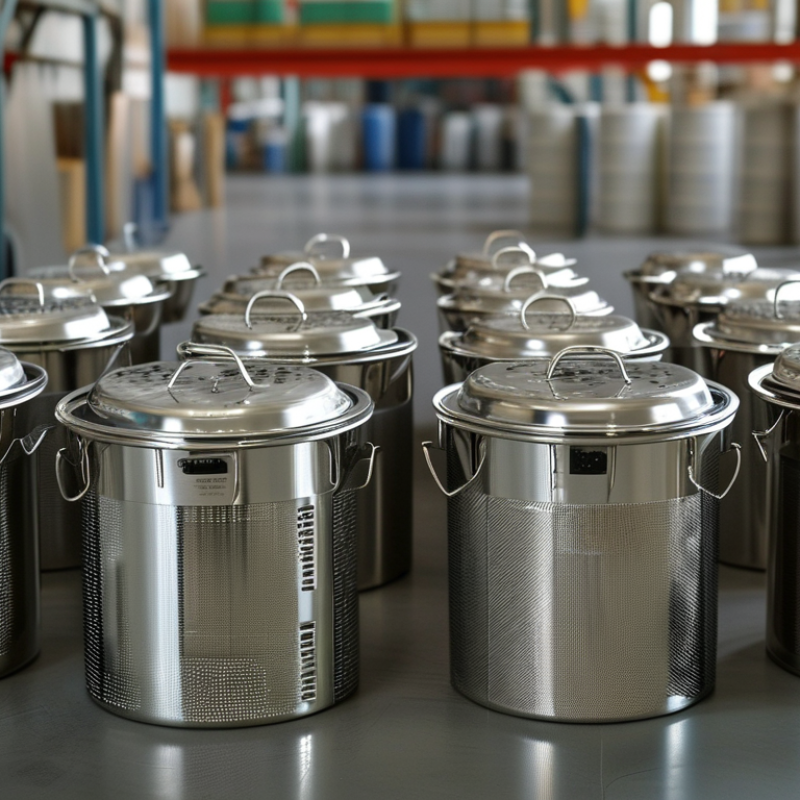
Filter Basket Basics: 304 vs. 316L Steel and 1–1000 μm Ratings
China’s filter basket suppliers commonly offer 304 and 316L stainless steel. The choice depends on fluid chemistry, temperature, and cleaning cycles. Type 304 contains about 18% chromium and 8% nickel. Type 316L adds roughly 2–3% molybdenum, improving resistance to chlorides and pitting. World Stainless Association data recorded 58.4 million tonnes of global stainless steel production in 2023, showing the material’s broad industrial role. However, high production volume does not guarantee suitable basket quality.
Micron ratings need closer inspection. A 1 μm basket offers finer retention than a 1000 μm basket, but the number may describe nominal or absolute filtration. ISO 16889 uses beta ratios to evaluate filter performance under multipass testing. Therefore, buyers should request the test method, wire diameter, opening tolerance, and flow-rate data. A woven mesh marked “50 μm” may not behave like a certified absolute 50 μm filter. This detail is often missed.
304 suits many water, oil, and general process applications. 316L is safer for saline fluids, coastal equipment, and aggressive cleaning chemicals. The wrong grade can develop staining, pitting, or shortened service life. Ask suppliers for material certificates, dimensional inspection records, and weld-finish details. ISO 2942 also provides a recognized framework for verifying filter integrity. One practical weakness remains: supplier test data may use different conditions, making direct comparisons imperfect. Global buyers should compare identical media, pressure, temperature, and rating definitions before selecting among China’s top filter basket suppliers.
China Filter Basket Supplier Guide: 304 vs. 316L Steel and 1–1000 μm Ratings
Nominal filter ratings commonly range from 1 to 1,000 μm. The logarithmic scale shows the large difference between fine and coarse filtration levels. Stainless steel selection should consider the process medium, chloride exposure, temperature, cleaning chemicals, and required mechanical strength.
304 Stainless Steel
A widely used austenitic stainless steel for general-purpose filter baskets, food-processing equipment, water service, and many non-chloride applications.
316L Stainless Steel
Contains molybdenum and generally provides better resistance to chlorides and aggressive chemical environments than 304. It is often selected for marine, pharmaceutical, and chemical-processing service.
Filter ratings are nominal specification points in micrometres (μm). Actual separation performance depends on basket geometry, wire diameter, perforation or mesh design, pressure drop, loading conditions, and the applicable test method. A smaller micron value indicates finer filtration.
Industry Standards: ISO 16889 Beta Ratios, Flow Rates, and Pressure Drop
China Top 10 Filter Basket Suppliers for Global Buyers
For global buyers, supplier claims should begin with test evidence, not catalog language. ISO 16889 uses a multipass test to evaluate filter performance under controlled conditions. Its beta ratio compares upstream and downstream particle counts at a stated particle size. A Beta 200 result means one particle passes for every 200 particles entering the filter. It does not mean absolute removal.
Flow rate must match the intended fluid, viscosity, temperature, and basket geometry. A supplier may quote 100 liters per minute, but that figure can change sharply with thicker oil or a finer mesh. Ask for test conditions and the effective filtration area. Small baskets often create high surface velocity. That detail matters.
Pressure drop is equally important. Request clean-element pressure-drop curves at several flow rates. Compare the starting differential pressure with the system’s allowable limit. A low initial drop can indicate an open design, but it may reduce particle retention. A high drop can overload pumps and shorten service intervals. I have seen buyers compare only nominal micron ratings. That approach is incomplete.
ISO 16889 results may not represent every basket application, especially when the test element differs from the production design. Confirm material, weld quality, sealing method, dimensions, and connection tolerances. Reliable suppliers should provide traceable reports, inspection records, and repeatable sampling methods. Some documents still lack viscosity details. That deserves careful questioning.
China’s Top 10 Suppliers: Products, Capacity, Certifications, and Export Reach
China’s top 10 filter basket suppliers serve food processing, chemical, pharmaceutical, water treatment, and industrial equipment buyers. Their products include stainless-steel baskets, perforated screens, wedge-wire units, and custom filter cylinders. Common materials include 304 and 316L stainless steel, with pore sizes often specified in microns or mesh ratings.
Capacity differs widely. Larger workshops operate laser cutters, CNC presses, welding lines, and automated polishing cells. Smaller factories may offer better customization but weaker process control. The WTO World Trade Statistical Review 2024 reports that China supplied about 14% of global merchandise exports in 2023. This supports broad export reach, but export volume does not prove filtration expertise. Buyers should inspect batch records, dimensional reports, and production samples. Certifications may include ISO 9001, material certificates, pressure-test records, and food-contact documentation where applicable. These documents must match the actual production site, not only a trading office.
Tips: Ask for three recent export references. Check welds under magnification. Confirm tolerances in writing. A useful weakness is often overlooked: suppliers may quote mesh accuracy without defining testing methods. Compare inspection standards, packaging details, replacement support, and delivery capacity. UN Comtrade data can help verify declared trade patterns, but it cannot confirm factory capability. That requires an audit, video inspection, or independent pre-shipment testing.
Supplier Comparison: MOQ, Lead Time, Mesh Tolerance, and Customization
Global buyers should compare filter basket suppliers by measurable performance, not catalogue size. A 2024 industrial filtration report from Grand View Research forecasts sustained market growth above 6% annually through 2030. That growth increases pressure on procurement teams. MOQ is often the first practical barrier. Standard baskets may begin at 50–100 pieces, while formed or welded designs can require 500 pieces. Confirm whether samples count toward the final order.
Lead time deserves equal attention. Typical production takes 20–35 days for standard baskets and 45–75 days for custom tooling. Shipping is additional. A supplier promising ten days may exclude inspection or packaging. Ask for a dated production schedule. Small details matter.
Mesh tolerance needs technical wording. ISO 3310-1 provides recognized test methods for woven wire cloth, while buyers should request aperture tolerance, wire diameter, and inspection records. “100 mesh” alone is insufficient. Some suppliers report nominal openings without explaining variation. That can affect flow and particle retention. Customization may include diameter, rim profile, handle position, welding pattern, and surface finish. Industry surveys frequently identify customization and shorter delivery as major purchasing factors, but faster is not always better. My own sourcing experience suggests that a pre-production sample prevents expensive corrections, although it can slow approval by several days. Ask for material certificates, dimensional reports, and retained samples. Mistakes still happen. Reliable documentation reduces their cost.
Buyer Due Diligence: ASTM A240 Materials and EN 10204 Test Certificates
China Top 10 Filter Basket Suppliers for Global Buyers
Buyer Due Diligence: ASTM A240 Materials and EN 10204 Test Certificates
Global filter demand is expanding. Grand View Research valued the industrial filtration market at approximately USD 41.9 billion in 2023. Its 2024 assessment forecasts a 5.2% compound annual growth rate through 2030. These figures explain the crowded supplier market, but they do not prove material quality.
For filter baskets, request ASTM A240 documentation before approving production. Confirm the stainless grade, heat number, plate thickness, chemical composition, and mechanical results. Common grades include 304 and 316L, yet grade names alone are insufficient. Match the certificate heat number with the basket’s material marking and purchase order. Portable PMI testing can expose a mismatch. It is not perfect, either.
EN 10204 is equally important. A 3.1 certificate should identify the manufacturer, product, heat, test results, and authorized inspection release. A 3.2 certificate adds independent inspection or purchaser-appointed verification. Ask for signed originals, not only edited scans. The International Stainless Steel Forum reported stainless steel production above 60 million tonnes in 2023, showing the scale of the supply chain and its traceability challenge. A certificate can still look complete and fail an audit. Review weld penetration, mesh attachment, dimensional tolerance, and surface condition with photographs. Suppliers sometimes overlook small traceability gaps. Buyers should not.




