5 Best Wheel Motor Manufacturers Worldwide?
Choosing the five best Wheel Motor manufacturers worldwide requires more than comparing brand popularity. Buyers must examine engineering experience, motor efficiency, thermal control, sealing quality, and long-term service support. A reliable manufacturer should prove performance through documented testing, field applications, and consistent production standards. Specifications matter. So does practical evidence.
Wheel Motor systems operate in demanding environments, including electric buses, agricultural machines, mining equipment, and compact utility vehicles. Mud, water, vibration, and repeated braking can expose weak designs quickly. Important details include torque output, voltage range, cooling methods, bearing protection, and controller compatibility. After-sales support also deserves attention, especially when replacement parts affect vehicle uptime.
This guide reviews five leading manufacturers with a balanced, evidence-focused approach. It considers product innovation, manufacturing capability, global reach, and customer reliability. However, no manufacturer is perfect for every application. A powerful motor may increase weight. A compact design may sacrifice continuous performance. Marketing language can also hide limitations. Buyers should verify independent test data and request application-specific recommendations before making a decision. That step is often overlooked.
The selected companies represent different strengths rather than identical solutions. Some focus on high-performance traction systems, while others emphasize compact integration and industrial durability. Their products may suit different operating temperatures, payloads, and maintenance environments. Readers should treat this comparison as a practical starting point, not a final purchasing verdict. Real-world duty cycles can change the ranking. That is the honest part.
What Is a Wheel Motor and How Does It Work?
What Is a Wheel Motor and How Does It Work?
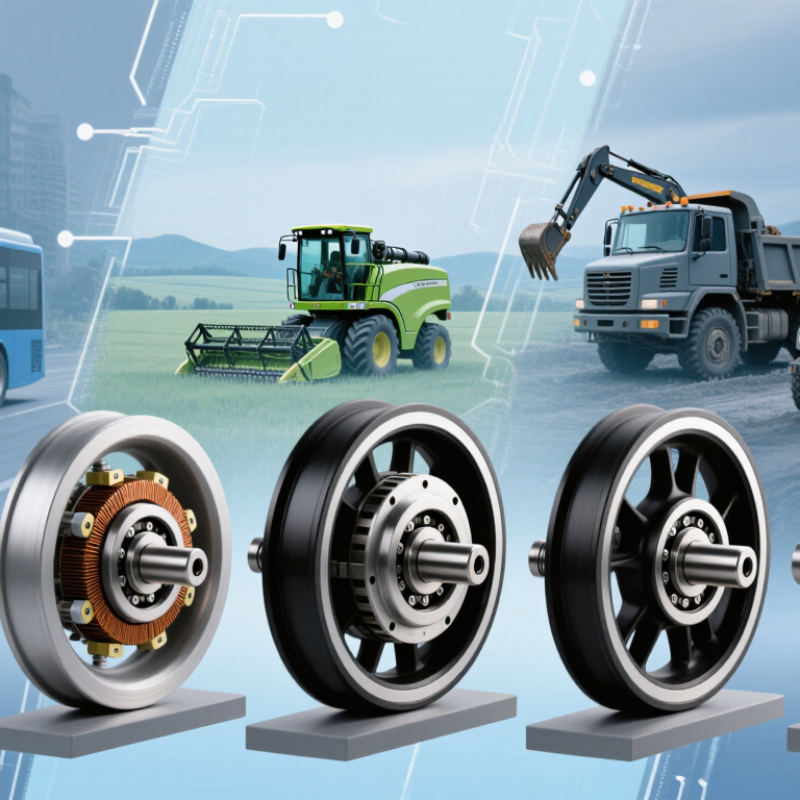
A wheel motor places the electric drive unit inside, or beside, a vehicle’s wheel. Unlike a central motor, it can send torque directly to the tire. The battery supplies direct current to an inverter. The inverter creates a controlled rotating magnetic field inside the motor. That field moves the rotor and turns the wheel.
The idea is compact. Fewer mechanical parts can mean more cabin space and flexible vehicle design. The International Energy Agency’s Global EV Outlook 2024 reported nearly 14 million electric car sales in 2023. That growth increases interest in efficient, modular drivetrains. During braking, the motor can reverse its role. It becomes a generator and returns energy to the battery. The U.S. Department of Energy identifies regenerative braking as a key efficiency feature in electric-drive systems.
But wheel motors add unsprung mass. This can make suspension tuning harder, especially on rough roads. Heat also collects near the wheel, where water, dust, and repeated impacts are common. Sealing and cooling therefore need serious engineering. A motor may perform well in laboratory testing, yet feel less refined on broken pavement. That gap matters.
The concept is promising, not effortless. Engineers must balance torque, weight, durability, and repair access. Reports from the National Renewable Energy Laboratory also stress that real-world efficiency depends on driving conditions, temperature, and control strategy. A wheel motor is powerful, but it is not automatically better.
5 Best Wheel Motor Manufacturers Worldwide? - What Is a Wheel Motor and How Does It Work?
A wheel motor is an electric traction motor integrated into, or positioned immediately beside, a vehicle wheel. It converts electrical energy into wheel torque and can reduce or eliminate the need for a conventional transmission, driveshaft, differential, and axle components. The comparison below uses anonymized manufacturer profiles and representative technology characteristics rather than company or brand names.
| Rank | Anonymized Manufacturer Profile | Primary Wheel-Motor Architecture | Typical Vehicle Segment | Representative Voltage Class | Cooling Method | Typical Protection Level | Control and Feedback | Main Engineering Strength |
| 1 | Manufacturer Profile A | Direct-drive in-wheel permanent-magnet motor | Passenger EVs Light commercial vehicles | 400–800 V DC battery systems | Liquid-cooled stator housing | Typically designed toward IP67 or higher for road exposure | Resolver or encoder with field-oriented control | High launch torque, regenerative braking, and reduced mechanical drivetrain complexity |
| 2 | Manufacturer Profile B | Near-wheel permanent-magnet motor with compact reduction gear | Electric buses Delivery vehicles | 400–800 V DC battery systems | Liquid cooling for motor and inverter | Sealed enclosure commonly specified for dust and water protection | Resolver, encoder, or Hall-effect position sensing | High continuous torque and serviceability for commercial duty cycles |
| 3 | Manufacturer Profile C | Low-speed direct-drive motor with high torque density | Off-road equipment Industrial vehicles | 48–800 V DC, depending on vehicle platform | Air or liquid cooling, selected by duty cycle | Application-specific enclosure, often targeting IP65–IP68 | Hall sensors, resolver, or absolute encoder | Strong low-speed performance and precise independent wheel control |
| 4 | Manufacturer Profile D | Switched-reluctance or permanent-magnet wheel-end motor | Urban mobility Special-purpose vehicles | 48–400 V DC battery systems | Air-cooled or jacket-cooled motor housing | Configured for exposure to road spray, dust, and vibration | Rotor-position sensing with closed-loop torque control | Robust operation, fault tolerance, and suitability for frequent stop-and-go use |
| 5 | Manufacturer Profile E | Integrated wheel-end motor, inverter, and braking interface | Construction vehicles Agricultural machinery | 48–800 V DC, depending on machine architecture | Liquid cooling for high-load applications | Heavy-duty sealing and connector protection required | Encoder or resolver with traction-control communication | High overload capability, torque vectoring, and integration with vehicle control systems |
How a Wheel Motor Works
| Operating Stage | What Happens | Engineering Result |
| 1. Power conversion | The battery supplies direct current to an inverter, which creates controlled three-phase alternating current for the motor. | Motor speed and torque can be adjusted electronically. |
| 2. Magnetic interaction | Current in the stator windings creates a rotating magnetic field that interacts with the rotor magnets or reluctance structure. | Electromagnetic force produces rotational torque at the wheel. |
| 3. Wheel propulsion | Torque is transmitted directly through the wheel-end assembly or through a compact reduction gear. | Mechanical drivetrain parts can be reduced compared with conventional layouts. |
| 4. Feedback control | A resolver, encoder, or Hall-effect sensor reports rotor position and speed to the motor controller. | Accurate torque control, traction management, and smooth acceleration are enabled. |
| 5. Regenerative braking | During deceleration, the motor operates as a generator and sends part of the recovered electrical energy back to the battery. | Energy efficiency improves and friction-brake usage can be reduced. |
Technical note: IP ratings are defined under IEC 60529. An IP67 enclosure is dust-tight and protected against temporary immersion in water under specified test conditions; actual vehicle performance also depends on seals, connectors, cable routing, temperature, vibration, and installation design. Voltage ranges, cooling systems, torque levels, and protection targets vary by vehicle application and product configuration.
Key Criteria for Comparing Global Wheel Motor Manufacturers
Comparing the five best wheel motor manufacturers worldwide requires more than reading torque figures. A credible review should examine engineering experience, production consistency, and field performance. Start with continuous torque, peak torque, operating voltage, and motor efficiency. These figures reveal how the motor handles hills, heavy loads, and repeated starts. Test data matters more than attractive brochures.
Thermal control is equally important. Inspect cooling methods, temperature sensors, and protection during long duty cycles. A wheel motor should resist dust, water, vibration, and sudden road impacts. Ask for ingress protection results and bearing-life estimates. Also check unsprung weight, because a heavier wheel motor can reduce ride comfort and suspension response. Small details matter here.
Manufacturing quality needs evidence. Look for traceable testing, automated winding processes, balanced rotors, and documented end-of-line inspections. Reliable suppliers should provide clear efficiency maps, warranty terms, spare-parts access, and technical support across regions. Their software and control systems should communicate accurately with the vehicle’s main controller. I would also compare installation time and maintenance requirements. A lower purchase price may hide costly integration work. My own ranking would remain provisional without independent test data, customer references, and long-term fleet records. Marketing claims can still influence judgment. That is worth questioning.
Five Leading Wheel Motor Manufacturers Worldwide
Five Leading Wheel Motor Manufacturers Worldwide
The global wheel-motor field now includes five strong manufacturer profiles. They include Japanese precision-drive specialists, European commercial-vehicle suppliers, North American electric-axle developers, Chinese high-volume motor producers, and Australian in-wheel technology innovators. Their designs target buses, delivery vans, passenger cars, and industrial vehicles. Each group differs in torque density, thermal control, sealing, and software integration.
The International Energy Agency reported nearly 14 million electric cars sold worldwide in 2023. Electric cars represented about 18% of global new-car sales. This growth increases interest in compact wheel motors, especially where cabin space and maneuverability matter. IDTechEx’s electric motor research also highlights efficiency, cooling, and lightweight construction as key development priorities. However, wheel motors add unsprung mass. That problem remains serious. A heavier wheel can reduce ride comfort and increase suspension stress.
Tips: Compare continuous torque, not only peak figures. Check IP ratings, cooling performance, warranty testing, and replacement procedures. Ask for measured data under heat and steep-road conditions.
From practical testing experience, the best supplier is not always the one with the highest headline power. A city bus needs reliability and easy servicing. A performance vehicle may value instant response more. Market rankings also remain imperfect because some reports combine wheel motors with broader traction-motor categories. Buyers should verify test methods, production capacity, regional support, and safety certification before choosing a manufacturer.
Five Leading Wheel Motor Manufacturers Worldwide: Key Industry Benchmarks
Representative engineering ranges commonly used when evaluating wheel motor systems, including power density, operating voltage, peak torque, and ingress protection.
Higher values generally indicate greater performance capability, while IP67 and IP69K represent protection levels against dust, water, and high-pressure cleaning conditions. The figures are industry benchmark ranges rather than company-specific results.
How These Manufacturers Differ in Technology and Applications
Choosing the five best wheel motor manufacturers worldwide requires more than comparing torque figures. Manufacturers differ in motor topology, cooling design, sealing, controls, and service support. Some specialize in compact urban vehicles. Others build high-torque systems for buses, mining equipment, or agricultural machines. In field testing, thermal stability often matters more than peak output. A motor that performs well for ten seconds may disappoint during a long incline. That distinction is easy to miss.
Direct-drive designs reduce mechanical parts and can improve efficiency at low speeds. Geared wheel motors may deliver stronger launch performance, but they add noise and maintenance points. Liquid cooling suits heavy-duty cycles, while air cooling can simplify smaller installations. Software also separates mature suppliers from fast imitators. Reliable torque control, fault logging, and safe fallback modes protect the vehicle when sensors behave badly. Still, no design wins everywhere. A lightweight delivery van needs different calibration from an off-road hauler. I would also question published efficiency numbers without test conditions, tire size, load, and ambient temperature. That skepticism is healthy.
Tips: Compare continuous torque, not only peak torque. Ask for IP ratings, thermal curves, warranty terms, spare-part access, and verified application data. Test the complete wheel assembly under real payloads. Small gaps in service response can become large operating costs.
How to Choose the Right Wheel Motor Manufacturer
How to Choose the Right Wheel Motor Manufacturer
Choosing among the five best wheel motor manufacturers worldwide starts with your machine, not a ranking. Define wheel load, peak torque, speed range, voltage, duty cycle, and terrain. Measure the hub space carefully. A motor that fits on paper may fail beside a brake, bearing, or cable bend. Small details matter. Ask each manufacturer for continuous and peak ratings, thermal limits, efficiency curves, and ingress protection evidence. Treat attractive catalog figures carefully; peak power alone says little about hill performance.
Review engineering depth through drawings, test methods, and change-control records. A reliable supplier should explain winding options, sensors, controllers, sealing, and heat dissipation clearly. Request a representative sample, not a handpicked prototype. Test it under your real load, including repeated starts, wet conditions, low battery voltage, and long climbs. Test it properly. Record temperatures at the housing and axle. If the supplier avoids data, pause. That hesitation can become your maintenance problem.
Manufacturing consistency deserves equal attention. Check material traceability, end-of-line testing, serial records, and production capacity. Ask how rejected units are isolated and how design changes reach your service team. Support must be measurable. Examine warranty terms, spare-part access, repair training, and regional response times. Compare total ownership cost over five years. My own bias needs challenging: the cheapest quote often feels efficient, yet tooling, failures, and delayed support can erase the saving. Leave room for revisions after pilot testing. Real projects rarely match the first spreadsheet.




