Top 10 Machine Safety Door Manufacturers for Global Buyers
A machine safety door does more than separate people from moving equipment. It helps control access, contain hazards, and support predictable production. For global buyers, the right choice depends on the machine, the task, and the working environment. A sliding door beside a compact press has different demands from an interlocked access panel on a long assembly line. Details matter: clear opening width, visibility through the panel, cycle frequency, washdown exposure, and how quickly the machine stops.
A practical reminder for buyers: “A safety door is only effective when its design matches the hazard and the way people actually work.” This is an editorial principle, not a quotation attributed to a named specialist. A credible comparison should examine each manufacturer’s engineering support, customization options, documentation, and ability to serve the buyer’s region. It should also distinguish robust construction from features that genuinely improve safe access. A heavy door alone proves little.
This guide introduces ten Machine Safety Door manufacturers for global buyers. It offers a starting point, not a substitute for a site-specific risk assessment. Supplier claims deserve careful review, and product specifications can change. That part is easy to overlook. Buyers should confirm compatibility with the machine and ask how safety functions are validated before placing an order. The best choice is rarely the most impressive brochure. It is the door that fits the hazard, the workflow, and the people who use it every shift.
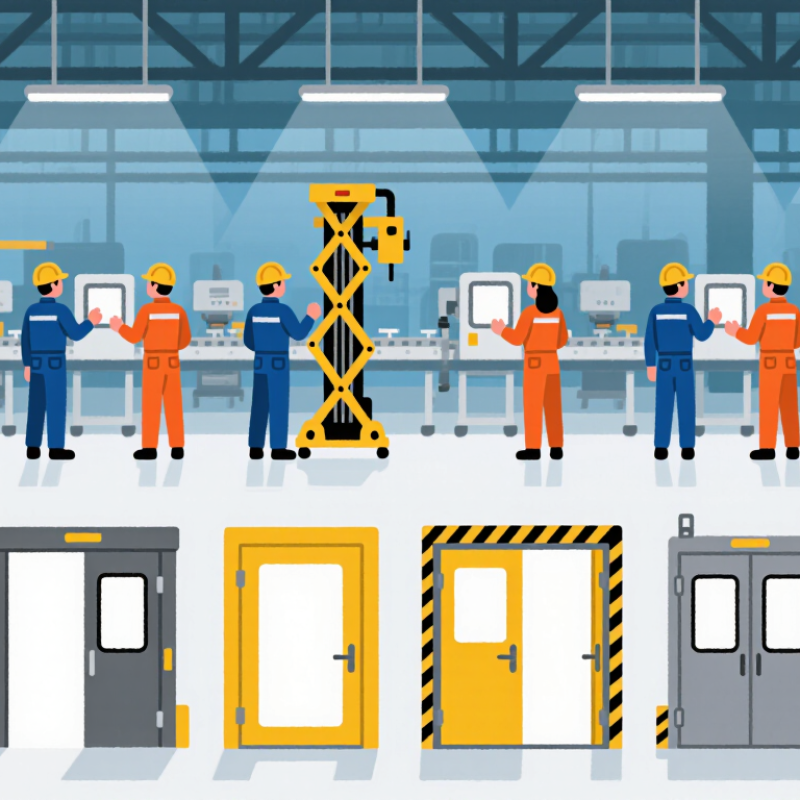
What Machine Safety Doors Are and How They Protect Workers
Machine safety doors are movable barriers fitted around hazardous machinery, such as robotic cells, presses, and automated packaging lines. They help keep hands and bodies away from moving parts, hot surfaces, and flying debris. A door-mounted interlock can signal the control system to stop hazardous motion when the door opens. Some machines also use guard locking, which keeps the door closed until dangerous movement has stopped. A visible gap matters. Even a narrow opening beside a hinge can invite someone to reach inside.
The protection depends on correct design and maintenance. OSHA’s machine-guarding standard, 29 CFR 1910.212, requires guarding against hazards such as points of operation and rotating parts. A safety door should be positioned to block foreseeable access, and its interlock should be tested during routine inspections. Never assume a stopped machine is safe to enter. Maintenance may require energy isolation and a site-specific procedure. That detail is easy to overlook.
The stakes are significant. The International Labour Organization’s 2023 estimates report about 2.93 million work-related deaths and 395 million non-fatal work injuries worldwide each year. These figures cover many causes, not machine doors alone, but they show why practical safeguards matter. A door that sticks, is bypassed, or closes too slowly can undermine protection. Operators should report faults promptly, even when production is waiting. Safety systems are not perfect. Regular checks make their limits easier to spot.
Common Types of Machine Safety Doors and Their Applications
Machine safety doors control access to moving parts while allowing operators to load, inspect, and maintain equipment. OSHA’s FY2023 Top 10 most frequently cited standards recorded 1,644 citations for machine guarding, placing it seventh. That figure covers guarding broadly, not doors alone, but it shows why access points deserve careful design.
Hinged doors suit compact cells with occasional access, such as small presses or inspection stations. Sliding doors need less swing clearance and work well beside conveyors or in narrow production lines. Vertical-lift doors can preserve floor space around large machining centers. For robots and automated cells, interlocked doors stop hazardous motion when opened; guard locking may be needed if equipment takes time to stop. Fit matters.
Door choice depends on the task, not just the machine. A frequently used loading gate should open smoothly and provide a clear view of the work area. Maintenance doors need enough clearance for tools and component removal. Poorly positioned hinges or awkward handles can invite workarounds. Still, adding more interlocks is not always better: a difficult reset can disrupt work and weaken safe routines. Risk assessment should consider access frequency, stopping time, visibility, and cleaning needs.
Common Types of Machine Safety Doors and Their Applications
Typical application examples by safety-door type
Counts represent the typical application examples summarized for each door type in this chart. They are not market-share figures or performance ratings. Actual door selection depends on the machine layout, risk assessment, access needs, and applicable safety requirements.
Key Standards and Features to Compare Across Manufacturers
When comparing machine safety door manufacturers, start with the risk assessment, not the catalogue. ISO 14119 addresses interlocking devices associated with guards, while ISO 13849-1 covers the design of safety-related control systems. Ask suppliers to show how their door, switch, and control circuit meet the required performance level for your machine. A strong-looking door is not enough.
The ILO’s 2023 report, A Call for Safer and Healthier Working Environments, estimates nearly 3 million work-related deaths and 395 million non-fatal work injuries each year. These figures cover many causes, not machinery alone, but they underline why safety claims need evidence. Compare test records, validation documents, and stated operating life—not just cycle-life promises. Check whether guard locking suits the machine’s stopping time, and whether an escape release is available where someone could become trapped. Small details matter.
Look closely at materials, hinge strength, visibility, and resistance to dust, washdown, or vibration. Confirm electrical documentation against IEC 60204-1 and ask how faults are detected and reset. This is easy to overlook. A supplier may provide compliant components, yet the finished installation can still be poorly integrated. Request clear instructions for mounting, wiring, inspection, and replacement; then verify them on the actual production line. Datasheets help. They are not proof.
Profiles of Ten Machine Safety Door Manufacturers
A custom enclosure manufacturer builds doors around unusual machine layouts, including angled frames and narrow service gaps. Its strength is fit. Buyers should check how changes affect lead time. A modular-frame producer offers adjustable aluminum profiles, clear panels, and replaceable hinges. This suits equipment that changes during development. A high-speed door maker focuses on frequent access, using flexible curtains and compact drives. Ask about cycle testing, not just opening speed. A sliding-door specialist designs wide openings for tool changes and maintenance. Smooth travel matters.
A robotic-cell guarding manufacturer integrates doors with fixed panels and access points. Look closely at sensor placement and cable routing. A washdown-focused producer uses corrosion-resistant materials and sealed joints for wet production areas. Cleaning details matter. A compact-machine supplier makes small access doors for inspection and routine adjustments. Its products may save space, but handles can be awkward with gloves. A heavy-duty gate manufacturer serves presses and large machinery, where frame stiffness and secure latching are critical.
An engineering-led manufacturer can survey a site and tailor guarding to specific equipment. That service is valuable, though project scope should be documented clearly. An export-oriented producer may offer multiple door sizes, spare parts, and installation guides. Confirm that drawings match the delivered hardware. A final profile is the specialist in retrofit doors, designed to fit older machines without extensive frame changes. Measurements are unforgiving. Even experienced buyers sometimes overlook clearance for hinges, cables, or a worker’s hand.
How Global Buyers Can Evaluate Suppliers and Support Services
When comparing machine safety door manufacturers, look beyond product dimensions and quoted prices. Ask how the supplier verifies door alignment, locking performance, and operation under repeated use. Request drawings, test records, and clear installation instructions. Details matter. A sample inspection can reveal awkward handles, exposed pinch points, or doors that are difficult to clean.
Support quality matters after delivery. Confirm who answers technical questions, which time zones are covered, and how quickly replacement parts can be shipped. Ask whether remote troubleshooting is available and what information technicians need, such as control-system details or photos of the installation. Check whether training includes maintenance staff, not only machine builders. Ask for references from buyers with similar equipment and operating conditions. Claims are easy to make.
A reliable supplier should explain what its service covers and where it does not. Compare warranty terms, spare-part availability, and procedures for reporting faults. Keep the answers in writing. No checklist catches every issue; site layouts, operator habits, and production changes can expose gaps later. That is worth admitting. A supplier’s willingness to discuss limitations may be more useful than a flawless sales presentation.




